Large Apartment Complexes (25+ Units): What Changes When You Cross Into Institutional Territory
A 24-unit building is valued by its NOI, managed by a third-party firm, and financed with a commercial bank loan. The 26-unit building next door is valued by its NOI too. But that extra two units crosses a threshold where lenders change, competition changes, and the operational infrastructure required to compete starts to look less like property management and more like running a business with employees.
Same block. Different game entirely.
Who This Is For
If you own, are analyzing, or are working toward a large apartment complex of 25 units or more, this post breaks down the five strategies used to operate them, what each one looks like in practice, and how the financial dynamics differ from anything covered in the earlier parts of this series.
This is Part 4 of a 16-week series covering every major real estate asset class. Part 1 covered single family homes. Part 2 covered duplexes, triplexes, and fourplexes. Part 3 covered small apartment buildings in the 5-25 unit range. If you want a financing foundation before going further, see which loan fits which property type.
The Problem: At 25+ Units, You Are Not Competing With Other Investors. You Are Competing With Institutions
Everything in Parts 1, 2, and 3 of this series operated in a world where individual investors dominated the buyer pool. A fourplex buyer competes with other small landlords and house hackers. A 15-unit buyer competes with small syndicators and local operators. At 25+ units, the buyer pool shifts. Regional operators, private equity funds, apartment REITs, and institutional syndicates are actively acquiring at this scale. They have professional underwriting teams, in-house construction management, established lender relationships, and operating platforms built over years. Competing with them requires understanding what they know.
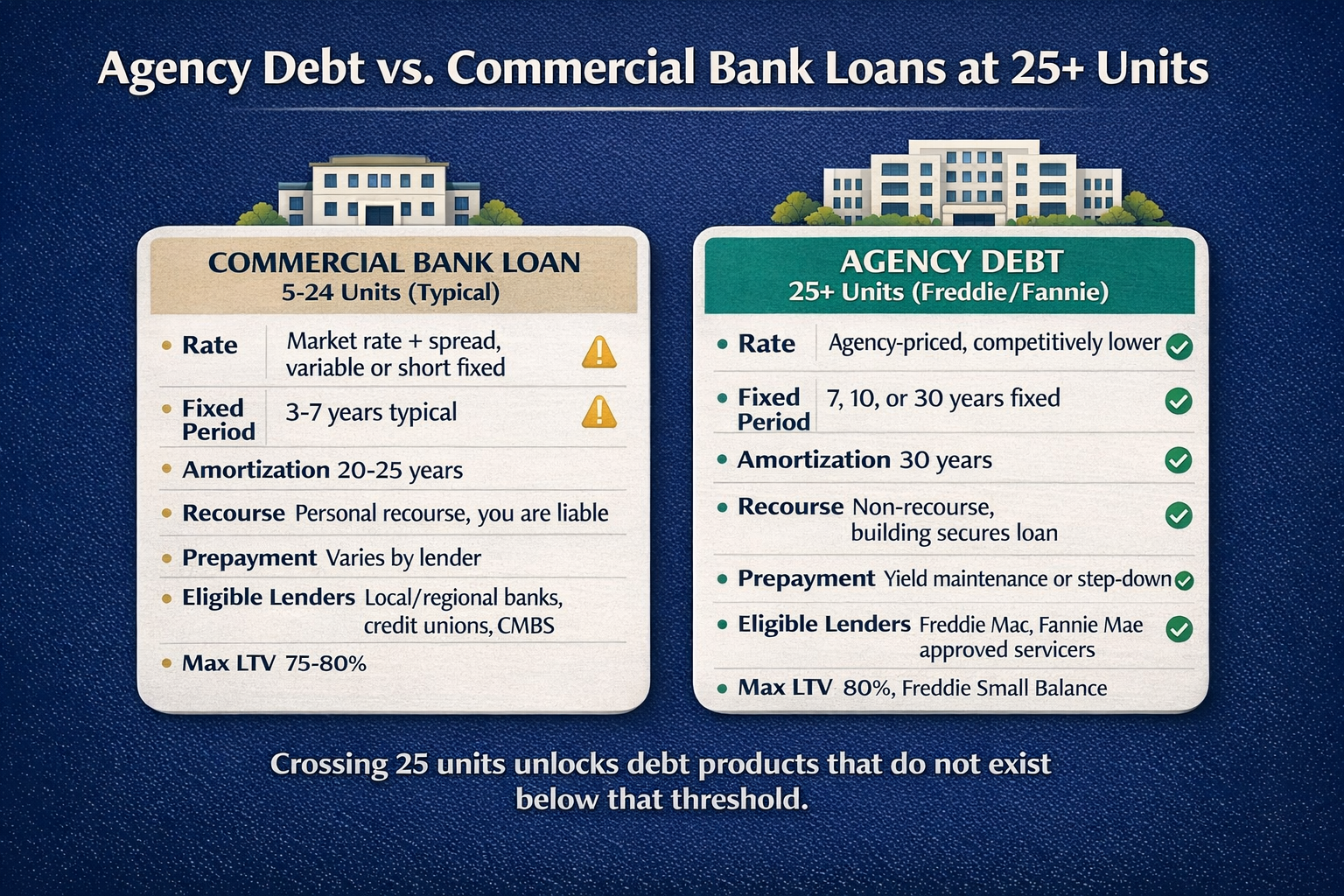
The financing shift. At 25+ units, a new class of debt becomes available: agency loans. Freddie Mac and Fannie Mae both have multifamily programs that lend on stabilized apartment buildings at this scale, and they are materially better than conventional commercial loans. Lower rates. Longer fixed periods. Non-recourse structure, meaning the loan is secured by the building alone and not by the borrower personally. Terms of 7, 10, or 30 years fixed. Amortization running to 30 years. These products are competitive because they are government-sponsored and priced accordingly. Getting to the 25+ unit threshold means access to this debt. It is a meaningful competitive advantage over the 5-24 unit range.
The staffing shift. A 20-unit building is managed by a third-party property management firm whose team is split across dozens of buildings in their portfolio. A 40-unit building typically justifies a part-time on-site manager. A 75-unit building needs a full-time on-site property manager plus a maintenance technician. A 150-unit complex needs a property manager, leasing agent, maintenance supervisor, groundskeeper, and possibly a resident services coordinator. At this scale, payroll is a line item. You are not outsourcing to a property manager as a vendor. You are building or inheriting an operating team.
The amenity shift. Tenants at larger apartment communities expect amenities. A 24-unit building might offer covered parking and in-unit laundry. A 100-unit complex competes on fitness centers, package lockers, co-working spaces, resort-style pools, dog parks, and EV charging stations. These are not optional luxuries. They are competitive requirements in markets where tenants have choices. Amenity investment drives lease-up velocity, reduces vacancy, and justifies premium rents, but it also requires capital, maintenance, and management capacity.
The capital shift. Deals at this scale require either significant personal capital, a lending relationship that provides high-leverage bridge financing, or a syndication structure that pools equity from multiple investors. Many 25+ unit transactions are done through limited partnerships or LLCs with multiple capital partners, because the equity requirement at 25% down on a $5 million property is $1.25 million, a number that demands either substantial personal wealth or institutional-grade capital formation.
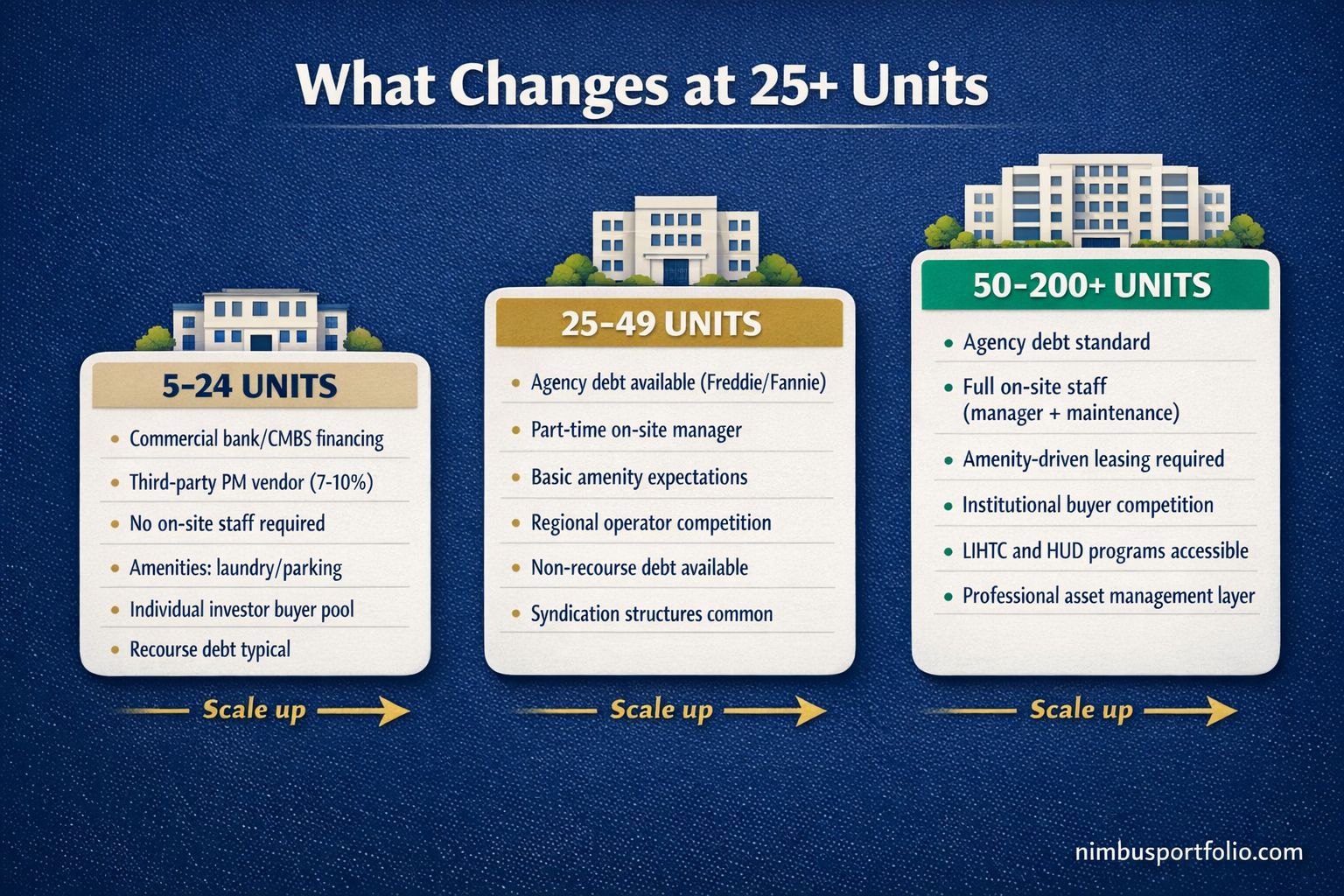

The five strategies below all operate in this institutional-adjacent space. Each uses the same financing products and the same NOI-based valuation framework. Each makes fundamentally different decisions about tenants, rents, amenities, and management.
Strategy 1: Core-Plus Stabilized
What it is: Buying a well-occupied, well-maintained apartment community at a modest discount to core (institutional grade) pricing, then improving operations incrementally to push NOI higher over a 5-7 year hold. Not a full repositioning project. Not a ground-up development. Steady, methodical improvement of an already-functioning asset, funded by the property's own cash flow.
Real example: A 48-unit garden-style community in a growing secondary market. Current occupancy: 93%. Average rent: $1,150/unit. Gross monthly income: $55,200. Operating expenses at 46%: $25,392. Monthly NOI: $29,808. Annual NOI: $357,696. Purchase price: $4,770,000 at a 7.5% cap rate.
Financed with a 10-year Freddie Mac agency loan at 6.25% fixed, non-recourse, 30-year amortization, 25% down ($1,192,500). Annual debt service: approximately $267,000. Net cash flow after debt service: roughly $90,696/year. Cash-on-cash return: 7.6%.
The core-plus improvement plan runs over three years: refreshing common areas (new lighting, fresh exterior paint, updated signage), adding package lockers at $18,000 installed, restriping and sealing the parking lot, and renewing leases at 3-4% annual increases. No unit-level gut renovation. Total improvement budget: $140,000, funded from operating cash flow. By year three, average rents reach $1,285/unit. NOI climbs to $407,000. At the same 7.5% cap rate, the building is worth $5,427,000. That is $657,000 in value creation on a $140,000 improvement budget, while collecting cash flow throughout.
Why agency debt changes this math: The non-recourse 30-year amortization structure means the investor is not personally liable if the building underperforms, and principal paydown is meaningful from day one. By year seven, the loan balance has dropped by approximately $380,000, which is equity created entirely by debt service. Agency debt is the structural advantage that makes core-plus attractive relative to the returns it appears to deliver on paper.
Metrics that matter:
- NOI growth year over year. The core-plus play is an NOI growth story, not a renovation story.
- Cap rate at purchase vs. projected cap rate at exit. Buying at 7.5% and selling into a 6.5% cap rate market on higher NOI compounds returns significantly.
- Agency loan terms: rate, fixed period, prepayment penalty structure. A 1% prepayment step-down over 9 years affects exit timing decisions.
- DSCR at acquisition and projected at stabilization. Agency lenders require 1.25+ DSCR at closing.
- Total return including principal paydown and appreciation, not just cash-on-cash. See the total return on equity breakdown.
Management intensity: Moderate. A part-time on-site manager handles day-to-day leasing and tenant relations. A regional property management company provides oversight, accounting, and maintenance coordination. The investor's role is quarterly reviews, capital improvement decisions, and lender reporting.
Best for: Investors moving up from the small apartment space who want access to agency debt and institutional-grade assets without the complexity of a full value-add repositioning. Also well-suited for 1031 exchange buyers who need a large, income-producing asset with minimal repositioning risk to deploy significant capital.
Strategy 2: Value-Add Institutional
What it is: The same value-add repositioning playbook from Part 3's Strategy 1, executed at institutional scale. Buy a 50-150 unit community with below-market rents and deferred capital investment, renovate units systematically as leases expire, raise rents to market, and refinance or sell into the higher NOI. The math is the same. The execution requires a team, a capital plan, and a construction management infrastructure that smaller buildings do not demand.
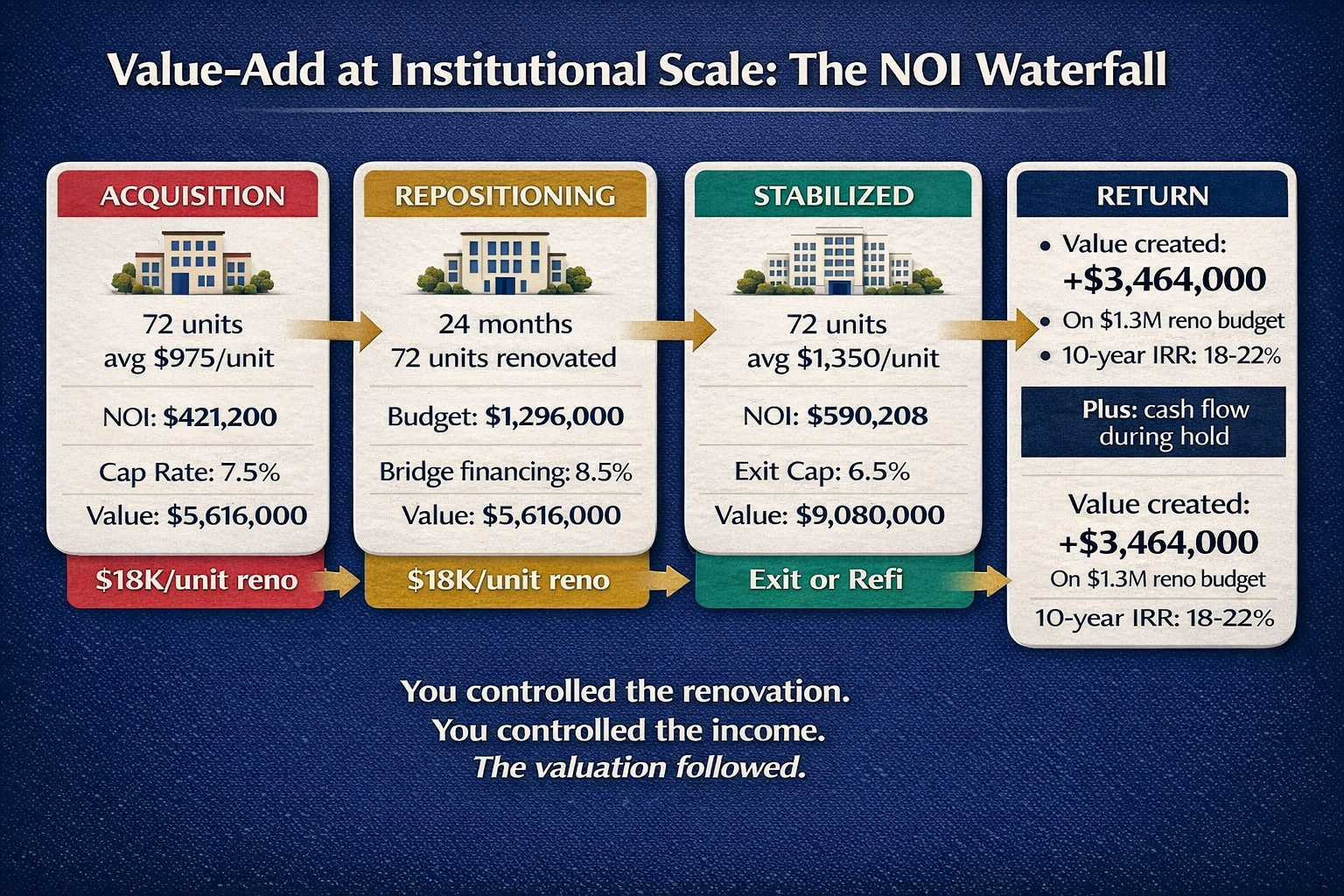
Real example: A 72-unit apartment community built in 1988 in a growing suburb. Current average rent: $975/unit. Comparable renovated units in the market: $1,350/unit. The building is purchased for $5,616,000, reflecting its current NOI of $421,200 at a 7.5% cap rate.
The renovation plan: $18,000 per unit for kitchens (cabinet refacing, new countertops, appliance package, LVP flooring), bathrooms (vanity, fixtures, tile surround), and in-unit washer/dryer hookup installation. Total renovation budget: $1,296,000, funded through a bridge loan structure that finances both the acquisition and the renovation capital.
Execution timeline: 24 months. Units are renovated in batches of 8-10 as leases expire. No relocation assistance required because no tenants are displaced mid-lease. At month 24, 60 of 72 units have been renovated and are leasing at $1,350/unit. Twelve units retain original tenants on existing leases at $975-$1,050/unit.
New stabilized gross income: $1,113,600/year. At 47% operating expenses: NOI of $590,208. At a 6.5% exit cap rate (lower than acquisition cap because the building is now a Class B renovated community, not a Class C unrenovated one), the building is worth $9,080,123.
That is $3.46 million in value creation on $1.296 million in renovation capital, before accounting for cash flow generated during the repositioning.
What changes at this scale: A 12-unit value-add deal can be self-managed through the repositioning phase by a skilled hands-on operator. A 72-unit value-add requires a construction superintendent or owner's representative on-site coordinating subcontractors, a leasing team managing turnover velocity, a property manager maintaining building operations while half the units are under renovation, and a lender relationship sophisticated enough to structure bridge-to-agency financing. The execution complexity multiplies with unit count. The returns multiply proportionally.
Metrics that matter:
- Renovation cost per unit vs. rent increase per unit. $18,000 producing $375/month additional rent pays back in 48 months and permanently increases building value.
- Bridge loan terms: rate, extension options, construction draw schedule. Bridge financing at 8-9% while repositioning is expensive. The timeline to agency refinance matters.
- Stabilized NOI vs. in-place NOI. The gap between these numbers is the return.
- Exit cap rate assumption. A 72-unit community may trade at a tighter cap rate than a 12-unit building in the same market. Cap rate compression at exit amplifies returns.
- Cash-on-cash during repositioning vs. after stabilization. Budget for negative or minimal cash flow during the renovation period.
Management intensity: Very high for 18-30 months. After stabilization, reverts to moderate. This strategy requires professional construction management, an on-site leasing team during lease-up, and a property management firm experienced in value-add execution. Many syndicators hire dedicated asset managers whose sole focus is driving repositioning timelines.
Best for: Syndicators with experienced operators and institutional capital partners who can execute at scale. Also for well-capitalized individual operators with construction experience and existing property management infrastructure. Not for first-time large-asset buyers.
Strategy 3: Workforce Housing at Scale
What it is: The workforce housing strategy from Part 3 applied to communities of 50-200 units. Clean, functional housing for working-class households at rents 10-20% below Class A, in well-located neighborhoods near employment centers. At this scale, the tenant retention advantage and occupancy stability that make workforce housing attractive become genuinely powerful because the numbers are large enough to absorb volatility while the income floor stays firm.
Real example: A 96-unit garden apartment community in a mid-size city. Average rent: $1,050/unit, roughly 15% below Class A rents in the surrounding market. Gross monthly income: $100,800. Operating expenses at 49% (slightly higher than Class A due to older building stock and higher maintenance frequency): $49,392/month. Annual NOI: $546,048. Purchase price: $6,826,000 at an 8.0% cap rate, reflecting the higher yield typical of workforce communities.
Financed with a Freddie Mac Small Balance Loan at 6.5% fixed for 10 years, 30-year amortization, non-recourse, 25% down ($1,706,500). Annual debt service: approximately $412,000. Net cash flow: $134,048/year. Cash-on-cash return: 7.85%.
Average tenant tenure in this building: 3.8 years. Annual turnover rate: 26%, meaning roughly 25 units turn per year. At $1,200 per unit turn (paint, cleaning, minor repairs, 12 days average vacancy), annual turnover cost: $30,000. The Class A building two blocks away, with market rents 15% higher, runs 58% annual turnover and spends $89,000/year on make-readies and vacancy loss. The workforce building generates less rent per unit and more income per year because tenants stay.
At 96 units, this stability advantage compounds. A 3% rent increase across all units adds $36,288 in annual gross income. Because tenants stay, that increase flows through with minimal turnover friction. A Class A building pushing the same 3% increase may see 15-20% of residents opt not to renew, triggering costly turnover exactly when the rent is rising. Stability at scale is not just a nice quality. It is a financial advantage.
What on-site staffing looks like at this scale: A 96-unit community justifies one full-time on-site property manager and one full-time maintenance technician. These two hires represent approximately $110,000-$130,000 in combined annual payroll plus benefits, roughly 13% of gross income. That cost is already baked into the 49% expense ratio. What those two employees buy is faster maintenance response, lower third-party repair costs, tenant retention through relationship quality, and a leasing presence that fills vacancies without paying a leasing fee to an outside broker.
Metrics that matter:
- Annual turnover rate. This is the operational metric that most directly predicts NOI performance.
- Cost per unit turn, tracked monthly. At 96 units, small per-unit improvements compound meaningfully.
- Occupancy rate vs. market occupancy. Workforce housing should run 95%+ in constrained supply markets.
- NOI per unit. Divide annual NOI by unit count and compare it quarterly. Declining NOI per unit is the early warning signal for operational problems.
- CapEx reserve adequacy. Older building stock at 96 units requires a funded reserve. Budget 10-12% of gross rents. Underfunded CapEx on a large building is a serious balance sheet risk.
Management intensity: Moderate to moderately high. On-site staff handles day-to-day operations. Regional management company provides accounting, compliance, and oversight. The investor's role is quarterly performance reviews, CapEx planning, and strategic lease-up or renewal decisions. More complex than a small apartment building, but the scale justifies the infrastructure.
Best for: Investors who want recession-resilient income, high occupancy stability, and access to agency debt at a scale where on-site operations become cost-effective. Workforce housing demand is countercyclical: downturns push higher-income renters into Class B and C units, increasing demand for exactly what this strategy provides.
Strategy 4: Mixed-Income with LIHTC
What it is: Combining market-rate units with Low Income Housing Tax Credit (LIHTC) units in a single community, structured to claim federal tax credits in exchange for maintaining a portion of units below market rate for 15-30 years. The credits reduce investor tax liability directly, which makes the financial returns on an otherwise lower-yield project competitive with market-rate alternatives. At 25+ units, the deal size is large enough to justify the compliance infrastructure LIHTC requires.
Real example: A newly constructed 80-unit apartment community. Sixty units leased at market rate: $1,300/unit ($78,000/month). Twenty units restricted to tenants earning at or below 60% of Area Median Income (AMI), leased at 60% AMI rent limits: $875/unit ($17,500/month). Total gross monthly income: $95,500. Annual gross: $1,146,000.
Operating expenses at 52% (higher than market-rate due to LIHTC compliance administration, annual audits, and tenant income certification costs): $595,920. Annual NOI: $550,080. But the story does not stop at NOI.
The LIHTC program awards tax credits equal to approximately 9% of eligible basis for new construction. On an $8 million construction cost, the credits run approximately $720,000/year for 10 years, totaling $7.2 million in federal tax credits that are sold to investors (typically large banks and corporations) through a tax credit equity syndication. That equity reduces the debt load on the building, which dramatically improves cash-on-cash returns for the operating partner despite the below-market rents on 20 units.
This is not a strategy for individual investors to structure from scratch. It requires a tax credit syndicator, tax credit legal counsel, a Housing Finance Agency allocation, and compliance systems that run for 15-30 years. But it is a structure worth understanding because experienced syndicators package LIHTC deals as limited partnership interests that individual accredited investors can participate in passively.
What the compliance layer looks like: Every LIHTC unit requires annual tenant income certification (verify the tenant still qualifies at 60% AMI), unit condition inspections, and reporting to the state Housing Finance Agency. Non-compliance puts the tax credits at risk of recapture, which is a significant financial liability. This is why the expense ratio on LIHTC buildings runs 5-8% higher than comparable market-rate buildings: compliance administration is a real operating cost.
Metrics that matter:
- Tax credit equity per unit vs. total project cost per unit. Credit equity typically covers 40-60% of project costs in a 9% LIHTC deal.
- Cash-on-cash return for the operating general partner vs. the limited partner tax credit investors. These are different return profiles.
- Compliance cost as a percentage of gross income. Budget 3-5% of gross for LIHTC administration.
- 15-year compliance period obligations. The restricted rents are locked in. Model the full 15-year cash flow at below-market rent levels before committing.
- Market-rate unit rent growth vs. AMI limit adjustments. AMI limits adjust annually based on HUD data, which gradually increases the allowable restricted rents. Track both.
Management intensity: High. On-site staff plus a compliance specialist or third-party compliance management firm. The market-rate units operate on standard lease management. The LIHTC units require certification workflows that run year-round. Many large property management firms have dedicated affordable housing compliance divisions.
Best for: Sophisticated syndicators and their accredited investor limited partners who want access to government-subsidized equity, tax credit income, and long-term stable cash flow at a scale where the compliance infrastructure can be efficiently staffed. Not appropriate as a solo investor's first large apartment deal.

Strategy 5: Amenity-Driven Class A
What it is: Developing or acquiring a luxury apartment community where the amenity package and unit quality command rents at the top of the local market. The strategy is rent maximization through product differentiation. You are not competing on price. You are competing on quality of experience, and you price accordingly.
Real example: A newly delivered 120-unit Class A mid-rise in a high-demand urban submarket. Average rent: $2,100/unit. Gross monthly income: $252,000. Amenity package: rooftop terrace with city views, resort-style pool and cabanas, fitness center with Peloton bikes and a yoga studio, co-working lounge with private conference rooms, pet spa and dog run, package lockers, concierge-level property management, EV charging in structured parking. The unit finishes: quartz countertops, stainless appliances, 9-foot ceilings, in-unit washer/dryer, smart locks and thermostats.
Operating expenses at 43% (lower than older buildings despite amenity maintenance costs, because new construction has minimal deferred maintenance). Annual NOI: $1,724,640. Purchase price or development cost: $27,594,000 at a 6.25% cap rate. Stabilized debt service on a $20,000,000 agency loan at 6.0% fixed for 10 years, 30-year amortization: approximately $1,439,000/year. Net cash flow: $285,640/year.
Cash-on-cash return at this price point is modest: roughly 3.7% on $7.6 million in equity. The return thesis is not cash flow. It is rent growth and cap rate compression over time. Class A buildings in high-demand submarkets historically outpace inflation on rent growth. As rents grow, NOI grows. As institutional capital chases stabilized Class A assets, cap rates compress. The combination of rent growth and cap rate compression drives equity appreciation that dwarfs the initial cash-on-cash return.
The lease-up risk: A 120-unit community going from 0% to 95% occupancy is a 12-18 month process. During lease-up, the building operates at a loss before NOI covers debt service. Concessions (one month free rent, waived parking fees) are standard to accelerate absorption. The capital plan must account for 12-18 months of carry costs before the building stabilizes. This is the risk that makes Class A development and acquisition more speculative than stabilized core-plus or workforce strategies.
Amenity as competitive moat: In a market where three new Class A communities delivered in the past 24 months, amenity differentiation determines which building reaches stabilization first. The building with the rooftop terrace leases up in 14 months. The building with a dated fitness center and no outdoor space takes 20 months. Those six extra months of concessions and lower occupancy represent $1.5 million or more in lost revenue on a 120-unit building. Amenity investment is not optional at this price point. It is competitive strategy.
Metrics that matter:
- Rent per square foot vs. competing Class A projects in the submarket. This is the competitive pricing metric.
- Lease-up velocity: units leased per month from construction completion. Benchmark against market absorption rates.
- Concession rates: free rent, waived parking, gift cards. These reduce effective rent and must be tracked separately from face rent.
- Long-term rent growth assumptions. Class A rent growth is highly correlated with job market strength in the submarket.
- Exit cap rate. Institutional buyers price Class A on a tighter cap rate than any other category. The exit cap rate assumption drives the entire return model.
Management intensity: High. A full-time on-site team of 4-6 people for a 120-unit community: property manager, assistant manager, two leasing agents, maintenance technician, and groundskeeper. The amenities require dedicated maintenance. Resident events, concierge services, and high-touch communication standards require trained staff. Professional property management firms that specialize in luxury multifamily charge 5-7% of gross rents, lower than the percentage on smaller buildings, but the absolute dollar amount is substantial.
Best for: Institutional investors, development groups, and well-capitalized syndicators who are positioning for long-term rent growth and cap rate appreciation in high-barrier-to-entry markets. Not appropriate for investors seeking immediate cash flow, investors without 12-24 months of capital reserves, or markets with significant new supply coming online in the near term.
Why the Numbers Work Differently at 25+ Units Than Everything Below
The valuation mechanics from Part 3's NOI explanation still apply here. What is different at large scale is the magnitude of the multiplier effect.
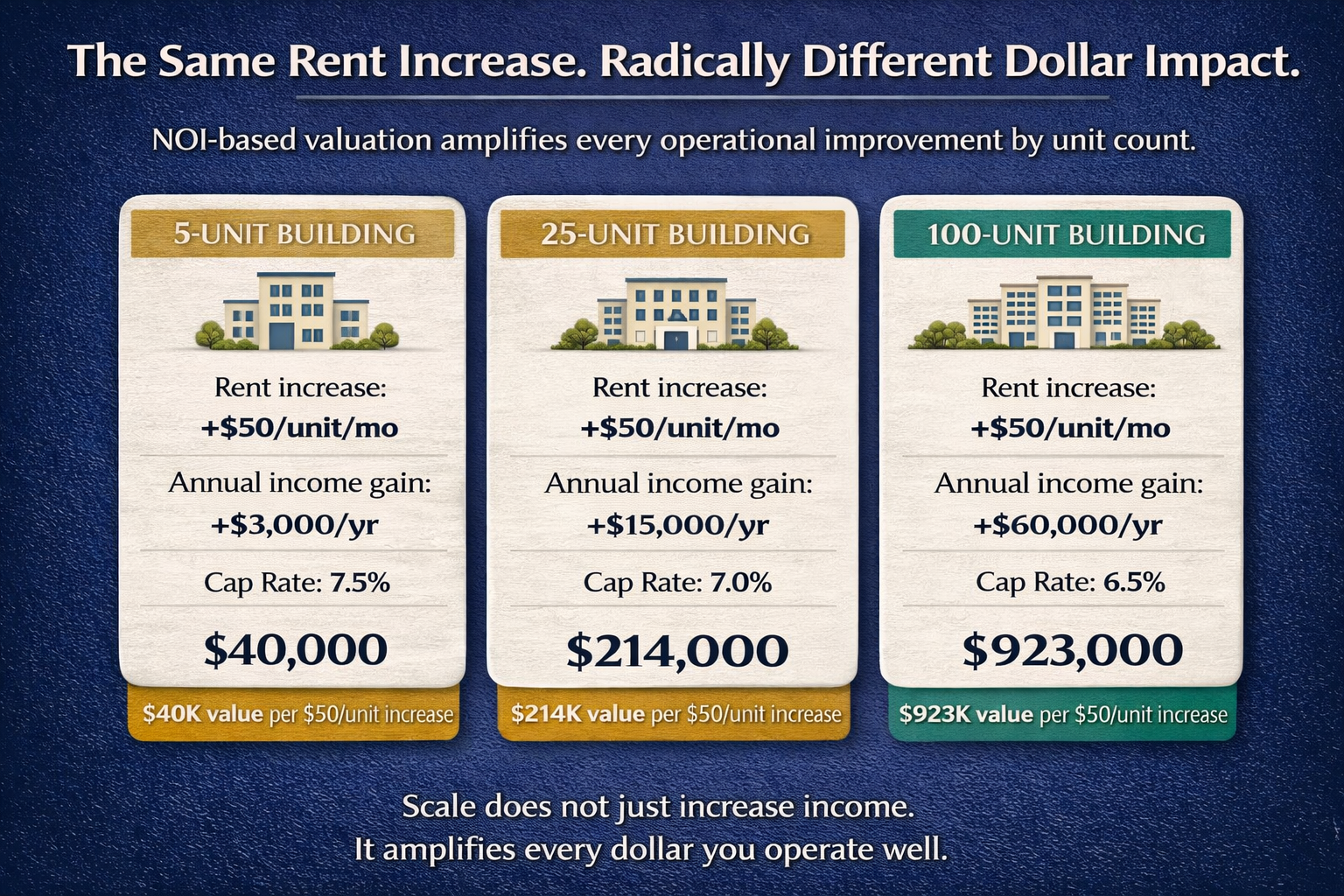
At 5 units, a $50/month rent increase creates $3,000/year in additional gross income. At 7.5% cap rate, that creates $40,000 in building value.
At 100 units, the same $50/month per-unit increase creates $60,000/year in additional gross income. At a 6.5% cap rate (tighter, because larger buildings trade at tighter caps), that creates $923,000 in building value.
The math is identical. The scale creates the separation. A management decision that takes one month to implement has a permanent, multiplied impact on asset value. This is why institutional operators obsess over occupancy rate, expense ratios, and per-unit revenue with a precision that looks excessive to someone managing a duplex. At 100 units, it is not excessive. A 1% improvement in expense ratio is $12,000/year in NOI, which is $185,000 in building value at a 6.5% cap rate. Every line item matters in a way that is simply not true at four units.
For a broader view of how leverage interacts with these NOI-driven returns, and how your equity position changes as values compound, the leverage explainer covers the math from portfolio level.
How Nimbus Handles This
A 72-unit apartment community generating $1.1 million in annual gross income is a significant operating business. Tracking it the way you would track a duplex, in a spreadsheet or a residential property management app, means losing visibility into the financial signals that determine whether the building is performing or slowly deteriorating.
Nimbus Portfolio tracks large apartment complexes at the property level with the metrics that matter at this scale: NOI, cap rate, cash-on-cash return, DSCR, expense ratio, equity position, and valuation history with monthly snapshots. When you drill into a property, you see income and expenses, loan details, and performance trends over time. Not a summary. The actual financial picture for that specific building.
The portfolio view is where complexity becomes clarity. If you own a single family rental in Atlanta, a small apartment building in Phoenix, and a 40-unit complex in Nashville, Nimbus rolls all three into a single dashboard: total equity, total cash flow, overall ROI, and asset allocation by type. The three properties use different financing structures, different valuation methods, and different management approaches. Nimbus tracks them in the same place, in the same format, at the same time. See how a mixed portfolio looks from a single view.
Scenario modeling works at the property level too. You can model a refinance from bridge to agency debt, run a stress test on occupancy rate assumptions, or analyze a hold vs. exit decision on any asset in the portfolio. The buy scenario tool is available without an account if you are evaluating a new acquisition. The DSCR calculator and cash-on-cash calculator are both free and require no login.
Large apartment investing is where the numbers get large enough that tracking precision starts to directly affect outcomes. The way you monitor performance determines whether you catch a rising expense ratio before it erodes NOI, or whether you see it six months later in an annual summary.
What Comes Next in This Series
This is Part 4 of a 16-week series. Next up: commercial real estate. Office buildings, retail centers, and industrial properties bring triple-net leases, tenant creditworthiness as the primary risk metric, and a valuation framework that looks familiar after four parts of NOI-based analysis but operates with meaningfully different supply and demand dynamics.
Start Tracking Your Large Apartment Complex the Way Its Performance Demands
A 48-unit apartment community is not a rental property. It is a commercial asset whose value is a direct function of how well you operate it. The expense ratio, occupancy rate, and NOI you produce this year determine what the building is worth when you refinance or sell.
The strategy you are running, or the one the market has handed you, determines your competitive position, your income stability, your management burden, and how this asset fits your broader portfolio. Track it accordingly.
Add your first property in under two minutes and see your numbers the way they actually work. Get started at Nimbus Portfolio
Nimbus Portfolio tracks 19+ real estate asset types and categories. Free tier available. Portfolio plan at $24/month or $190/year. Portfolio+ at $49/month or $390/year.