Five Strategies for Small Apartment Buildings: What Changes When You Cross the 5-Unit Threshold
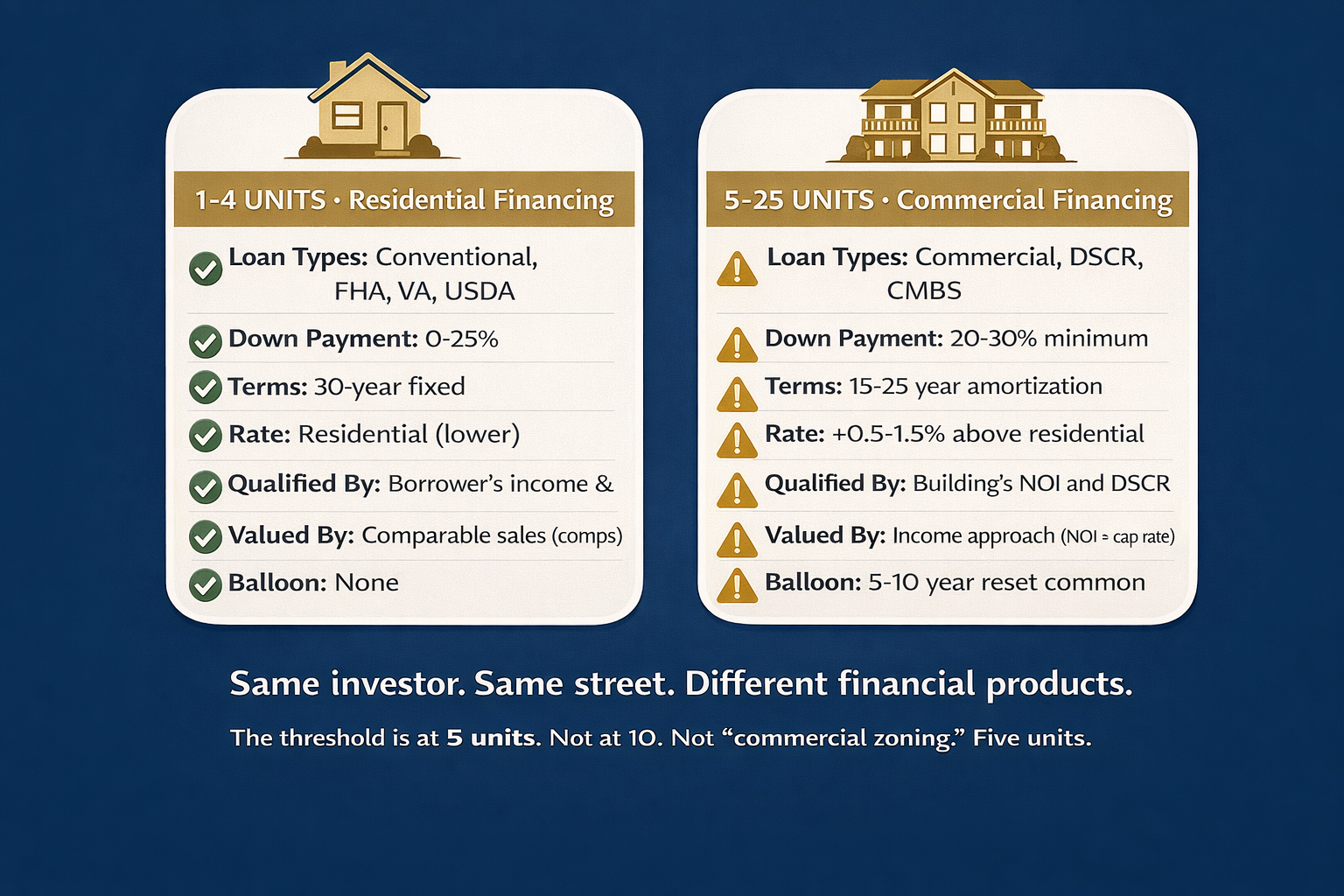
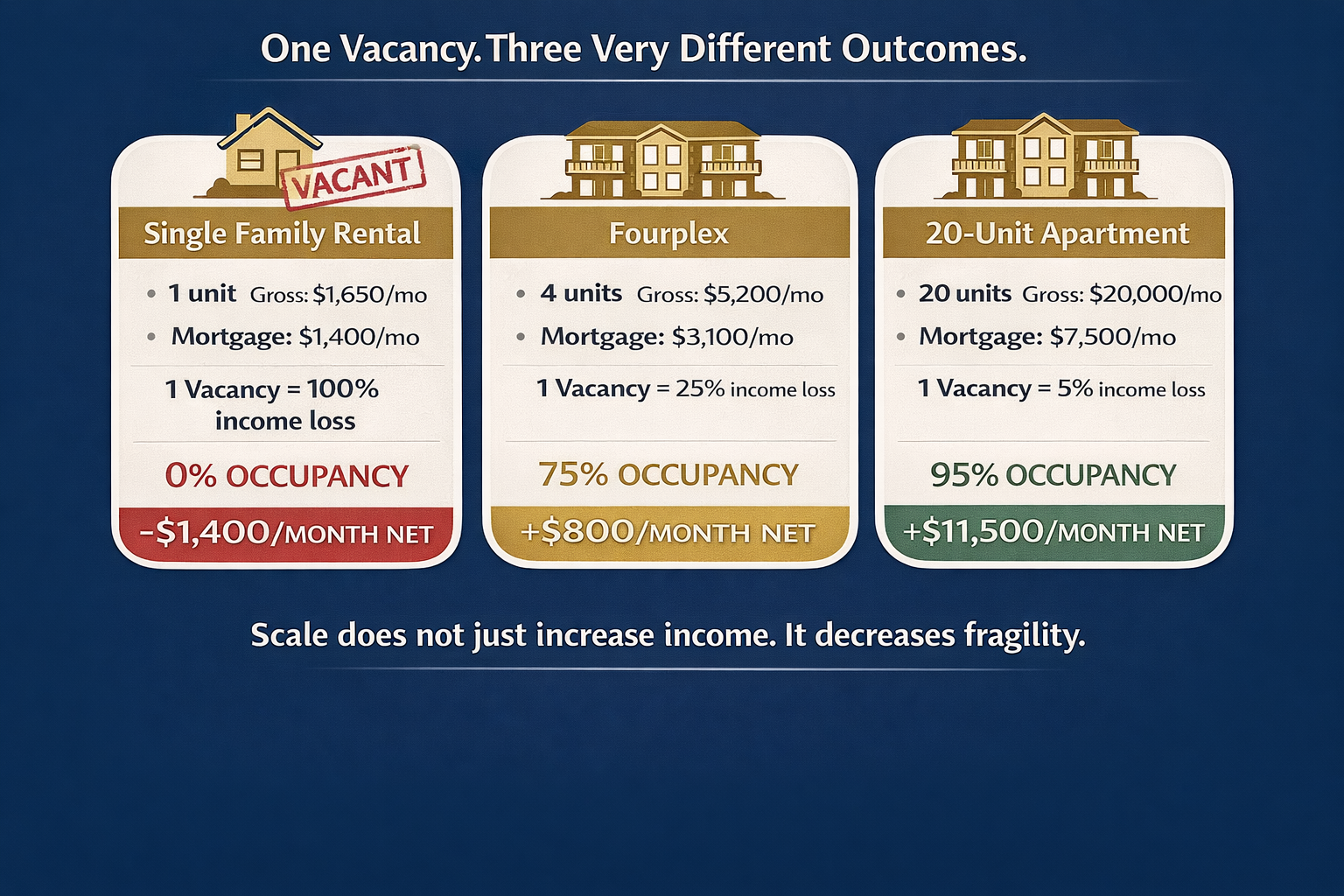
A fourplex investor closes with 3.5% down on an FHA loan. The building across the street has six units. Same neighborhood, same construction, same tenant base. But buying that six-unit requires 25% down, a commercial loan, and a lender who evaluates the building's income statement instead of the borrower's W-2.
Same street. Different financial universe.
Who This Is For
If you own or are analyzing a 5-25 unit apartment building, this post breaks down the five strategies used to operate them and what each one actually looks like in practice. It is also for fourplex investors considering their first step into commercial multifamily who want to understand exactly what changes at the five-unit line and why.
This is Part 3 of a 16-week series covering every major real estate asset class. Part 1 covered single family homes. Part 2 covered duplexes, triplexes, and fourplexes. If you want a financing overview before going further, see which loan fits which property type.
The Problem: The 5-Unit Line Is Not Arbitrary. It Rewrites Every Rule
In Parts 1 and 2, every strategy operated inside the residential financing envelope. Conventional loans, FHA at 3.5% down, VA at 0% down. Thirty-year fixed rates. Qualification based on the borrower's personal income. Valuation based on comparable sales.
At five units, all of that stops.
The financing cliff. No FHA. No VA. No conventional residential products. Five units and above means commercial lending. Down payments jump to 20-30%. Loan terms shorten to 15-25 years, often with 5-10 year balloon provisions that force a refinance or payoff. Interest rates are typically 0.5-1.5% higher than residential. And the lender evaluates the building's income, not the borrower's tax return. If the building does not generate enough NOI to service the debt, the loan does not close regardless of the borrower's personal wealth.
The valuation shift. A fourplex is valued by comparable sales. What did the similar fourplex down the street sell for? You cannot control that number. A twelve-unit apartment building is valued by its income. The formula: NOI divided by the market cap rate equals value. This is the single most consequential change at five units, because it means you can increase your building's value by increasing its income. Not by waiting for the market. By operating the building better.
The management shift. At 1-4 units, self-management is common and often practical. At 5-12 units, professional property management becomes strongly recommended. By 13-25 units, it is standard. The cost structure of the building changes: property management at 7-10% of gross rents, dedicated maintenance reserves, commercial insurance, and entity structuring become baseline operating expenses rather than optional overhead.
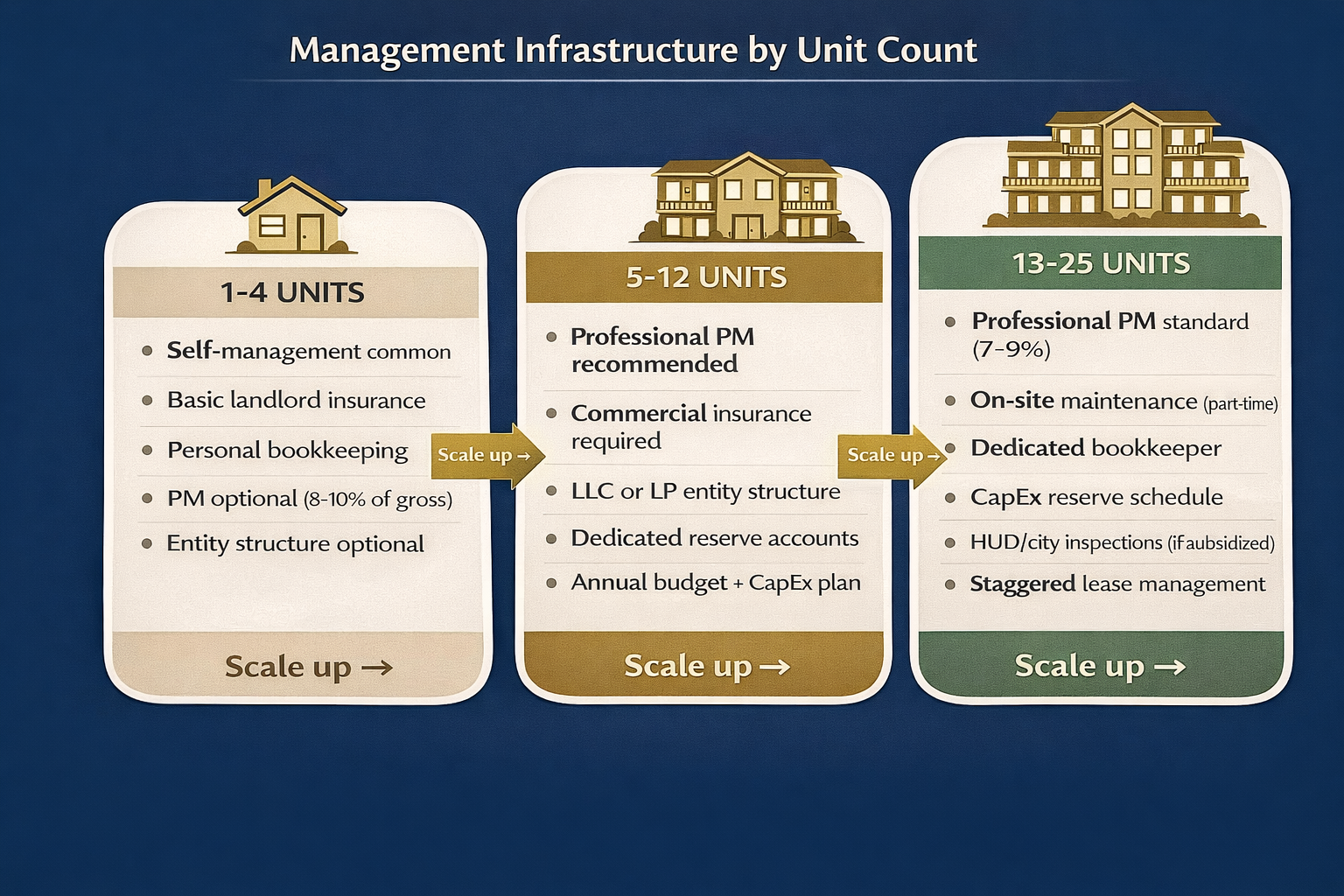
The five strategies below all operate in this commercial multifamily space. Each one uses the same financing products and the same valuation framework, but makes fundamentally different decisions about tenants, rents, risk, and management.
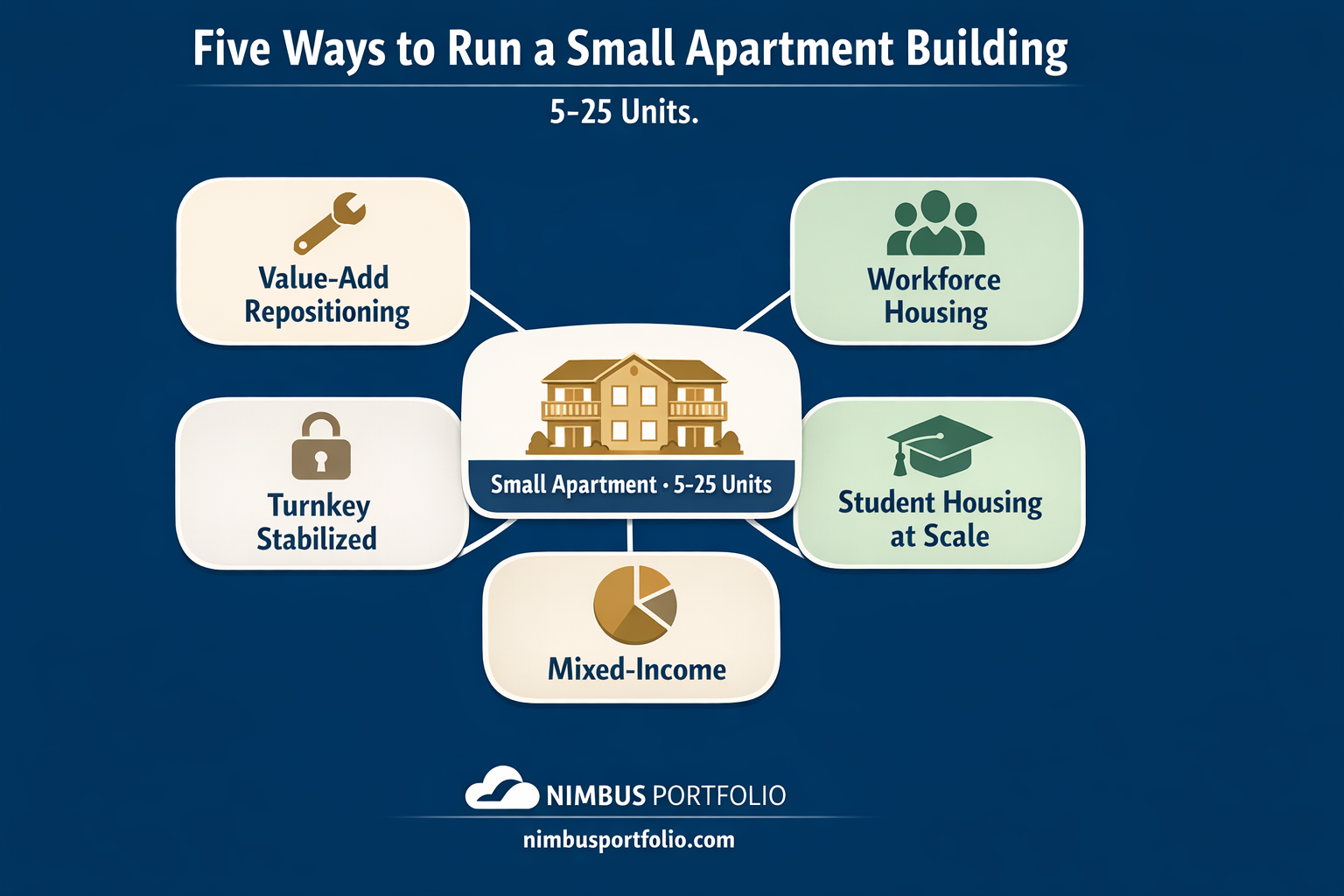
Strategy 1: Value-Add Repositioning
What it is: Buy an underperforming building, one with below-market rents, deferred maintenance, or poor management, at a price reflecting its current income. Renovate units as leases turn over. Raise rents to market. Refinance based on the higher NOI. The commercial version of the BRRRR strategy covered in Part 2, but the math works differently because the building is valued by income, not by comparable sales.
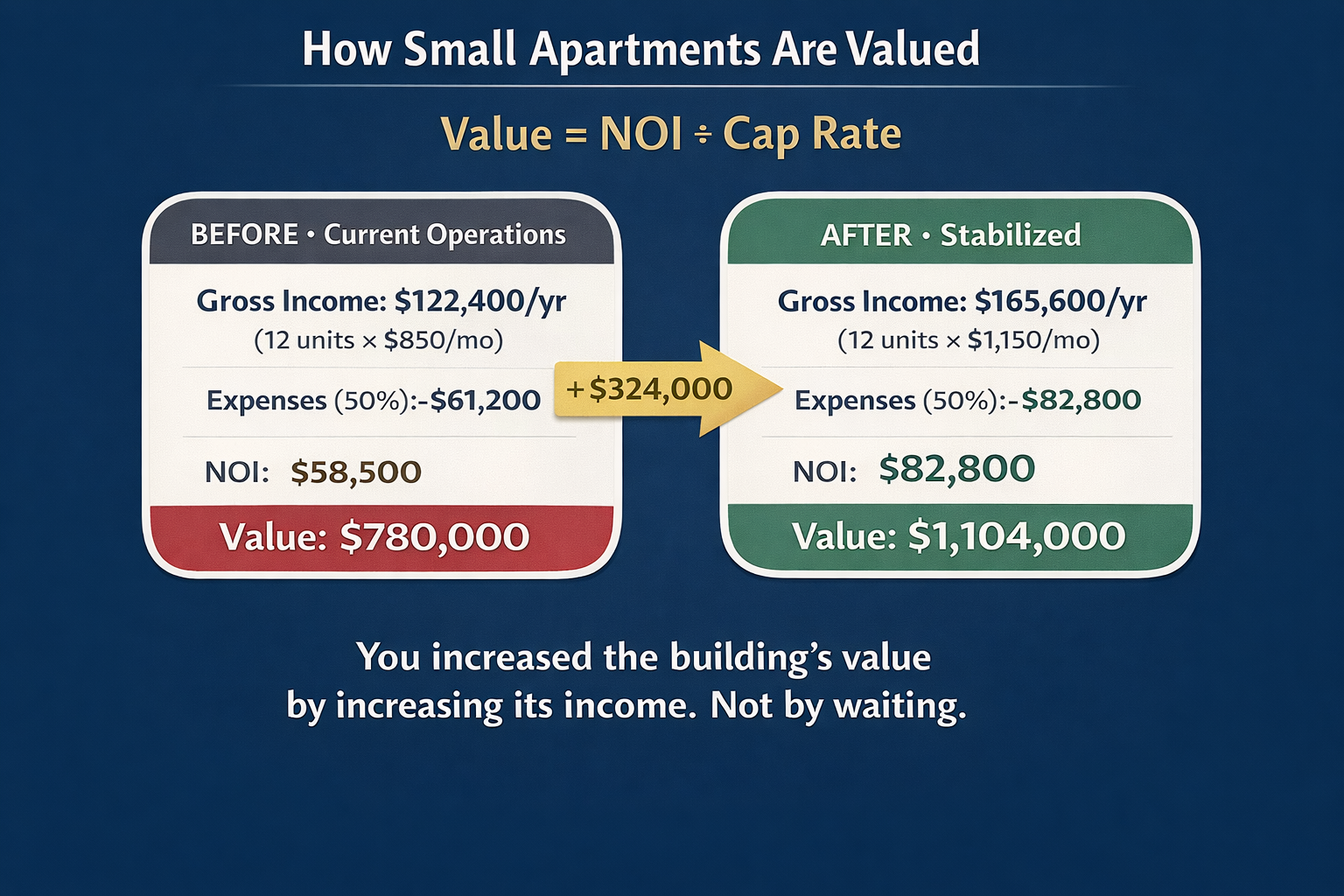
Real example: A 12-unit building in a secondary market. Current rents average $850/unit. Market rents for renovated units in the area: $1,150/unit. The building is purchased for $780,000, reflecting its current NOI of $58,500 at a 7.5% cap rate. The investor renovates four units per year at $12,000/unit ($48,000/year) as leases expire, upgrading kitchens, bathrooms, flooring, and fixtures. No tenants are displaced mid-lease.
After three years, all 12 units are renovated and leased at $1,150/unit. New gross income: $165,600/year. Operating expenses at 50% (including property management, taxes, insurance, maintenance, and reserves): $82,800. New NOI: $82,800. At the same 7.5% cap rate, the building is now worth $1,104,000.
That is $324,000 in forced appreciation, created entirely by improving the building's operations. Not by waiting for the market to move.
Why this works differently at 5+ units: In the 1-4 unit world, BRRRR depends on the appraiser finding comparable sales to justify the after-repair value. The investor controls the renovation but not the valuation. At 5+ units, the building is valued by its income. The investor controls both the renovation and the income, which means the investor controls the valuation. This is the fundamental advantage of commercial multifamily value-add.
Metrics that matter:
- Current NOI vs. pro forma NOI. The gap between these two numbers is the opportunity.
- Cap rate (NOI / property value). Because the building is valued by NOI, improving NOI directly increases the building's worth. See the DSCR explainer for how lenders evaluate this.
- Cost per unit renovation vs. rent increase per unit. $12,000 in renovation producing $300/month in additional rent pays back in 40 months and increases building value permanently.
- DSCR post-renovation and post-refinance. The new, higher loan balance requires the building to generate enough NOI to service it.
- Cash-on-cash return pre and post stabilization.
Management intensity: Very high during the repositioning phase (12-36 months depending on building size and turnover rate). Unit turns must be coordinated with lease expirations. Contractor management, budgeting, and rent-up overlap simultaneously. Stabilizes to moderate once all units are turned and fully leased.
Best for: Investors with construction or project management experience who are scaling up from the 1-4 unit BRRRR playbook. Also suits operators with existing property management infrastructure who can execute unit turns efficiently across a larger building.
Strategy 2: Workforce Housing
What it is: Providing clean, functional, affordable housing to working-class tenants: service workers, tradespeople, entry-level professionals, and families earning at or below 80% of Area Median Income (AMI). Rents are set below Class A market rates. The play is volume and retention, not rent maximization.
Real example: A 20-unit building in a mid-size city. Average rent: $925/unit, roughly 15% below Class A rents in the surrounding area. Gross monthly income: $18,500. Operating expenses at 48% (slightly higher than Class A due to maintenance on older building stock). Annual NOI: $115,440. Purchase price: $1,408,000 (8.2% cap rate, reflecting the slightly higher yields typical of workforce housing). With 25% down ($352,000) and a commercial loan at 7% on a 25-year term, annual debt service runs approximately $90,000. Net cash flow: roughly $25,440/year. Cash-on-cash return: 7.2%.
That number looks modest compared to a value-add play. The difference is risk-adjusted stability.
Workforce housing tenants have fewer housing options. They stay longer. Average tenure in this building: 3.2 years, compared to 1.8 years in the Class A building two blocks away. Lower turnover means fewer unit turns, fewer vacancy days, and lower make-ready costs. Over a five-year hold, the workforce building's cumulative cash flow often matches or exceeds the Class A building's because the Class A building bleeds cash during turnover months.
Metrics that matter:
- Occupancy rate. Workforce housing consistently runs 95%+ occupancy in markets with housing supply constraints.
- Tenant retention rate and average tenure. This is the metric that drives the economics.
- Maintenance cost per unit. Older buildings require higher CapEx reserves. Budget 8-12% of gross rents for maintenance and capital reserves.
- NOI per unit. The per-unit yield matters more than the gross rent number.
- Rent as a percentage of area median income. This determines eligibility for certain tax incentive programs and helps benchmark affordability positioning.
Management intensity: Moderate. Lower turnover means fewer unit turns, but older building stock requires more proactive maintenance. Professional property management at 8-10% of gross rents is standard. The management philosophy is retention-focused: responsive maintenance, reasonable rent increases, and consistent communication keep tenants in place.
Best for: Investors who prioritize stable, recession-resistant cash flow over maximum rent growth. Workforce housing demand is countercyclical: it increases during economic downturns when higher-income renters trade down. This is a defensive portfolio position.
Strategy 3: Turnkey Stabilized
What it is: Buying a fully occupied, well-maintained building at market cap rates and operating it as-is. No value-add play. No repositioning. No deferred maintenance. Pure cash flow from day one, with professional management handling operations and the investor providing oversight.
Real example: A 16-unit building in a stable suburban market. All units occupied on 12-month leases, staggered across the calendar year. Rents at market: $1,200/unit average. Gross monthly income: $19,200. Operating expenses at 45% (lower than older buildings because deferred maintenance is not a factor). Annual NOI: $126,720. Purchase price: $1,690,000 (7.5% cap rate).
With 25% down ($422,500) and a commercial loan at 7% on a 25-year term, annual debt service runs approximately $107,000. Net cash flow after debt service: roughly $19,720/year. Cash-on-cash return: 4.7%. Add in principal paydown on the mortgage (approximately $25,000/year in the early years) and the total return on equity looks considerably stronger.
Why investors buy turnkey at seemingly modest yields: Cash-on-cash alone does not capture the full return. Principal paydown, tax depreciation, and long-term appreciation all contribute. A stabilized 16-unit building with a 4.7% cash-on-cash return that also delivers 6% principal paydown return and 3% annual appreciation is generating a total return closer to 13-14%. The investor's day-to-day involvement is minimal because there is no repositioning project to manage.
Metrics that matter:
- Cap rate at purchase. Are you buying at a yield that reflects the market and the building's condition?
- Cash-on-cash return after leverage. Your actual annual yield on cash invested.
- DSCR. Should be 1.25+ for comfortable debt service coverage on a stabilized asset.
- Rent roll stability. Lease expiration schedule, tenant payment history, and average tenure.
- CapEx reserves needed. Roof, HVAC, plumbing, and parking lot on a 16-unit building are not trivial line items. A 10-year CapEx projection prevents surprises.
Management intensity: Low for the investor. Professional property management at 7-9% of gross rents handles day-to-day operations, tenant relations, and maintenance coordination. The investor's role is financial oversight, strategic decisions, and annual planning.
Best for: Investors transitioning from active 1-4 unit management into passive ownership of larger assets. Also well-suited for 1031 exchange buyers who need a stabilized, income-producing asset to defer capital gains into. And investors who want portfolio diversification without the time commitment of a repositioning project.
Style: Two clean cards side by side, Deep Sapphire (#0B1F3A) background, Cloud White (#F7F7F8) cards with Storm Gray (#4AA44A) and Nimbus Gold (#C8AA6E) accents. 1200x600px. */}
Strategy 4: Student Housing at Scale
What it is: The same per-bed leasing model covered in Part 2's student housing strategy, applied at the 5-25 unit scale near a major university. At this size, the management infrastructure that makes per-bed leasing viable spreads across enough beds to be efficient rather than burdensome.
Real example: A 10-unit building half a mile from a large state university. Each unit is a 4-bedroom/2-bathroom layout. Whole-unit leasing at market rate: $1,600/unit, or $16,000/month gross ($192,000/year). Per-bed leasing at $650/bed across 40 beds: $26,000/month gross ($312,000/year). The per-bed premium: 62.5% more gross revenue on the same building.
That premium comes with real costs. Forty individual leases. Forty move-ins in August. Forty move-outs in May. Summer vacancy running 2-3 months where occupancy drops to 40-60% unless the building runs a summer sublease program. Annual turnover costs per bed (paint, cleaning, minor repairs) at $400-$600/bed across 40 beds: $16,000-$24,000/year. Furnishing each unit (beds, desks, dressers) if offering furnished units: $3,000-$5,000/unit upfront.
Even after these costs, the math works. Annual gross of $312,000 minus 10 weeks of summer vacancy (roughly $65,000 in lost revenue at partial occupancy) minus $20,000 in turnover costs minus standard operating expenses at 45% of effective gross income: the resulting NOI significantly exceeds what whole-unit leasing produces. The margin is large enough to justify the management overhead.
What changes at this scale vs. a single fourplex: At 4 units and 12-16 beds, the investor manages per-bed leasing personally. At 10 units and 40 beds, that is not practical. This scale requires a property management system that handles individual lease tracking, a leasing team during the August and January peak seasons, standardized unit furnishing packages, and a summer occupancy strategy (sublease program, summer internship housing, or conference housing partnerships with the university). The infrastructure cost is real, but it amortizes across enough beds to be cost-effective.
Metrics that matter:
- Revenue per bed vs. revenue per unit. This is the core comparison that justifies the strategy.
- Academic-year occupancy vs. summer occupancy. Plan financially for the 2-3 month summer trough. Budget conservatively.
- Turnover cost per bed. Annualized across 40 beds, this is a meaningful operating expense line item.
- Total lease count and administrative cost per lease. Management overhead scales with headcount, not unit count.
- Parent co-signer rate. Higher co-signer rates reduce default risk materially.
Management intensity: High. Forty individual tenants, annual turnover cycles synchronized to the academic calendar, summer vacancy management, and furnishing maintenance. Professional student housing management is not optional at 10+ units. Many markets have property management firms that specialize exclusively in student housing.
Best for: Investors near large universities (15,000+ enrollment) who are willing to build or hire specialized student housing management in exchange for significant per-bed revenue premiums. The revenue upside is substantial, but the operational commitment matches it.
Strategy 5: Mixed-Income (Market Rate + Subsidized)
What it is: Operating a portion of units at market rate and a portion under subsidized housing programs, most commonly Housing Choice Vouchers (Section 8). The market-rate units provide rent growth upside. The subsidized units provide government-guaranteed income and, in some programs, tax credits. The blend creates a building with both stability and growth potential.
Real example: A 24-unit building. Sixteen units leased at market rate: $1,100/unit ($17,600/month). Eight units leased to Section 8 voucher holders at HUD Fair Market Rent: $1,050/unit ($8,400/month, with $6,800 paid directly by the government and $1,600 paid by tenants based on income). Total gross monthly income: $26,000. Annual gross: $312,000.
Operating expenses at 47%: $146,640. Annual NOI: $165,360. Purchase price: $2,067,000 (8.0% cap rate). With 25% down ($516,750) and a commercial loan at 6.75% on a 25-year term, annual debt service runs approximately $126,000. Net cash flow: $39,360/year. Cash-on-cash return: 7.6%.
The stability profile is what distinguishes this strategy. Eight of 24 units have government-guaranteed rent. The $6,800/month from HUD arrives on time regardless of individual tenant circumstances. On the market-rate side, 16 units have standard rent growth potential. If market rents increase 3% annually, the blended income grows while the subsidized floor holds steady.
Voucher holders also tend to have longer tenures. Losing a Section 8 voucher means years on a waiting list to get another one. This creates a strong incentive for tenants to maintain the unit and comply with lease terms. The result: lower turnover on the subsidized units, which reduces vacancy loss and make-ready costs for one-third of the building.
Metrics that matter:
- Market-rate unit revenue vs. subsidized unit revenue (tracked separately, never averaged)
- Government-guaranteed income as a percentage of total gross income. This is the income stability metric.
- Blended occupancy rate. Mixed-income buildings typically run higher occupancy than fully market-rate buildings.
- HQS (Housing Quality Standards) inspection compliance costs. Subsidized units require annual HUD inspections. Budget for this.
- Net cash flow by unit type. Understanding which units drive cash flow and which units drive stability lets you make informed decisions about the mix.
Management intensity: Moderate to high. The subsidized units require HUD compliance: initial inspection before move-in, annual re-inspections, additional paperwork for voucher renewals, and coordination with the local Housing Authority. The market-rate units operate under standard lease management. You are running two management workflows in the same building. Most professional property managers handle both, but confirm this capability before hiring.
Best for: Investors who want income stability through government guarantees while maintaining market-rate upside on the remaining units. Particularly attractive in markets where Section 8 Fair Market Rent meets or exceeds actual market rent for the unit type, which happens more often than most investors assume.
Why NOI-Based Valuation Changes Everything
This section is the reason experienced investors scale into commercial multifamily. It deserves its own explanation.
In the 1-4 unit world, your building is worth whatever the similar building down the street sold for. That is the comparable sales method. You cannot control it. You can renovate your property perfectly, manage it flawlessly, and fill every unit with excellent tenants. But if the neighbor sold at a low price, your appraisal reflects the neighbor's sale, not your operations.
At five units, the appraiser uses the income approach. Your building is worth its NOI divided by the prevailing cap rate. You control the NOI. Here is what that means in practice:
A 20-unit building with rents at $1,000/unit generates $240,000/year gross. At 48% expenses, NOI is $124,800. At a 7.5% cap rate, the building is worth $1,664,000.
Raise rents by $50/unit. New gross: $252,000. New NOI at 48% expenses: $130,960. New value at 7.5% cap: $1,746,133.
A $50/month rent increase across 20 units, $1,000/month in total additional revenue, created $82,133 in building value. That is not theoretical. It is how commercial appraisals work. Every dollar of NOI improvement is amplified by the cap rate into a multiple of building value.
This is why value-add repositioning (Strategy 1) is the highest-return strategy in small apartment investing. And it is why tracking NOI, expenses, and per-unit revenue with precision is not optional at this scale. The tracking is the valuation. For more on how equity and leverage interact with these returns, see the total return on equity breakdown and the leverage explainer.
How Nimbus Handles This
A 12-unit building generating $165,000 in gross revenue is a business. It needs business-level tracking at the property level.
Nimbus Portfolio tracks small apartment buildings the same way it tracks every asset class: at the property level, with the financial metrics that matter. NOI, cap rate, cash-on-cash return, DSCR, expense ratio, equity position, and appreciation over time. When you drill into any individual asset, you see the full financial picture for that property: income, expenses, loan details, valuation history, and performance trends.
The portfolio view is where the real clarity comes in. If you own a single family rental, a fourplex, and a 15-unit apartment building, Nimbus shows each property's financials individually and rolls everything up to a single portfolio dashboard. Total equity, total cash flow, overall ROI, asset allocation by type. One view across every property you own, regardless of asset class. No spreadsheet stitching. No separate trackers for "residential" and "commercial." See how a mixed portfolio looks from a single view.
Scenario modeling works at the property level too. You can model a buy scenario for a new acquisition, run a refinance analysis on an existing building, or stress test your portfolio against rate changes and vacancy scenarios. The numbers reflect the property as a whole, which is how lenders, appraisers, and operators actually evaluate these buildings.
If you are modeling a new acquisition, you can run the buy scenario with real numbers, check DSCR before you make an offer, and calculate your projected cash-on-cash return, all without creating an account.
What Comes Next in This Series
This is Part 3 of a 16-week series. Next up: what happens when the building gets big enough to need its own payroll. Large apartment complexes bring on-site staff, institutional capital competition, amenity-driven leasing, and a set of financial dynamics that make the 5-25 unit range look straightforward by comparison.
Start Tracking Your Small Apartment Building Like It Is a Business, Not a Rental
A 12-unit building is not a rental property. It is an income-producing commercial asset valued by its financial performance. The way you track it should reflect that: property-level financials, NOI trending, loan details, valuation history, and scenario modeling for your next move.
The strategy you are running, or the one you have defaulted into, determines your building's value, your cash flow stability, your management burden, and how your portfolio performs over time. Track it accordingly.
Add your first property in under two minutes and see your numbers the way they actually work. Get started at Nimbus Portfolio
Nimbus Portfolio tracks 19+ real estate asset types and categories. Free tier available. Portfolio plan at $24/month or $190/year. Portfolio+ at $49/month or $390/year.