Six Ways to Run a Duplex, Triplex, or Fourplex: The Strategies That Change When You Add Units
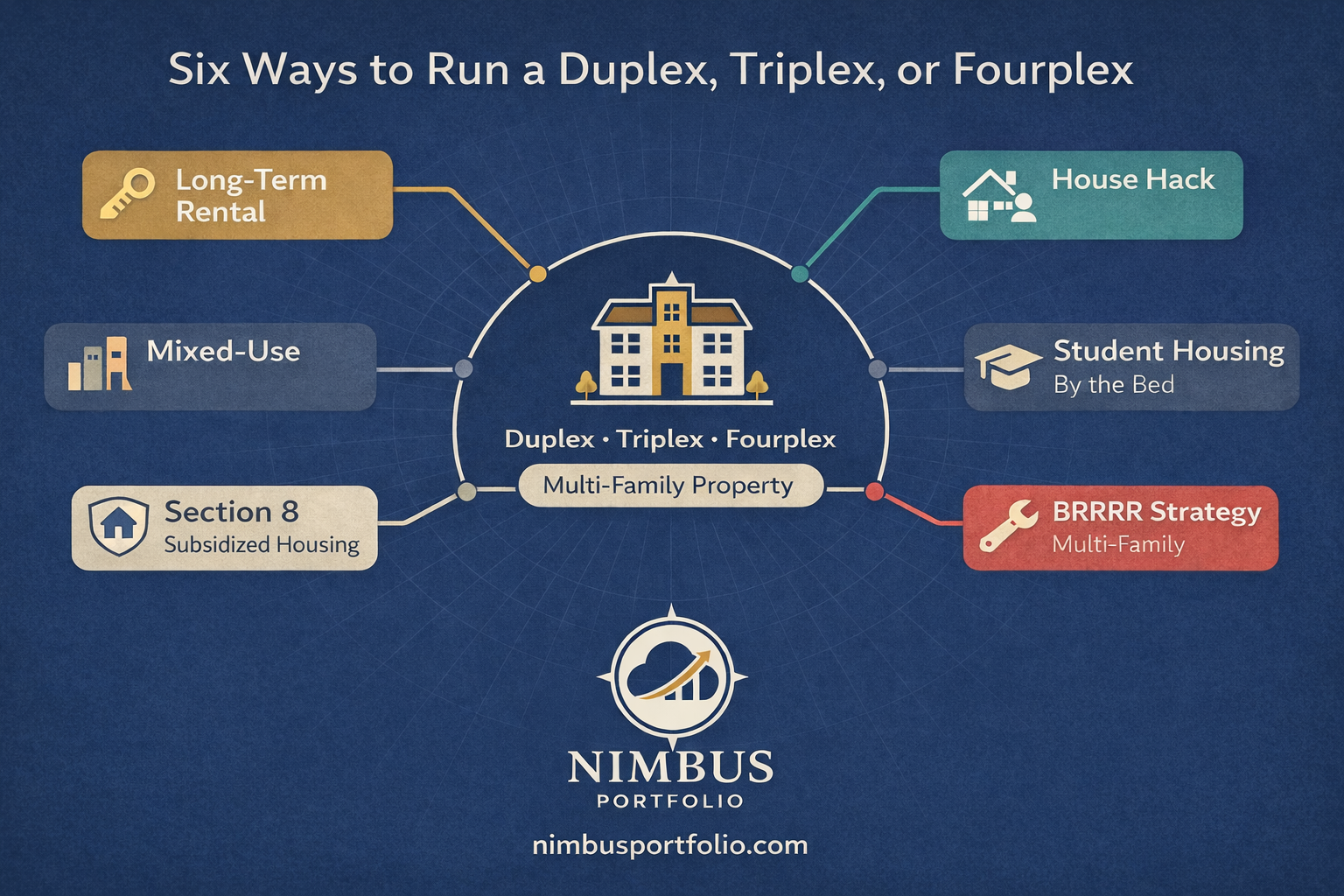
A duplex, triplex, or fourplex shares one residential financing framework but supports six distinct strategies: long-term rentals, house hacking, mixed-use, student housing by the bed, Section 8, and BRRRR. The strategy you pick determines cash flow, management intensity, and tenant profile, not the building itself.
A duplex and a fourplex look like the same category. Two to four units, residential zoning, one loan, one building. The financing works the same way. The tax code treats them the same way.
But the investor running them is making a completely different set of decisions, and the strategy determines whether the property is a portfolio engine or an expensive headache.
Who This Is For
If you own or are analyzing a 2-4 unit residential property, a duplex, triplex, or fourplex, this post breaks down the six strategies used to run them and what each one actually looks like in the numbers. It's also for investors considering their first multi-family purchase who want to understand what they're actually choosing between when they pick a strategy.
This is Part 2 of a 16-week series covering every major real estate asset class. Part 1 covered single family homes. If you want the financing overview before you go further, see which loan fits which property type.
| Part | Asset Class |
|---|---|
| 1 | Single Family Homes |
| 2 | Duplexes, Triplexes, Fourplexes (You Are Here) |
| 3 | Small Apartments (5-25 Units) |
| 4 | Large Apartments (25+ Units) |
| 5 | Commercial RE: Office, Retail, Industrial |
| 6 | Self-Storage Facilities |
| 7 | Mobile Home Parks (Coming Soon) |
The Problem: "Multi-Family" Is Not a Strategy. It's a Building Shape
Pull up any real estate portfolio tracker, any spreadsheet template, any app not purpose-built for this, and you'll find a single bucket labeled "multi-family." Sometimes it's "duplex." Sometimes it's just "residential."
That label misses the entire point.
A fourplex where the owner lives in one unit, rents two to long-term tenants, and runs one unit as a furnished MTR is three separate financial instruments under one roof. Averaging the income and calling it a "fourplex return" gives you a number that is technically computable and practically useless.
What changes between a duplex and a fourplex is not the financing, that is the same residential product for all 1-4 unit properties. What changes is the per-unit economics, the vacancy math, and the strategic optionality you have once you own the building.
Here is the critical financing fact that gets confused constantly: a duplex, a triplex, and a fourplex all qualify for conventional, FHA, and VA residential loans. The financing cliff is at five units, not at four, not at three. You do not cross into commercial lending territory until you hit a five-unit building. This matters enormously for down payment requirements, interest rates, and what you can do with the property as an owner-occupant.
The six strategies below all operate within this 1-4 unit residential financing envelope. Each one is a fundamentally different business decision.
Strategy 1: Traditional Long-Term Rental (All Units Leased)
What it is: Every unit is rented to long-term tenants on standard 12-month leases. No owner-occupancy, no short-term plays, no mixing strategies. Pure cash flow from a purely residential building.
Real example: A triplex in Kennesaw, GA. Three units at $1,400, $1,350, and $1,300 per month. Gross monthly revenue: $4,050. Operating expenses, including taxes, insurance, property management at 9% ($364/month), and maintenance reserves, run roughly $1,600/month. That's a net operating income (NOI) around $29,400/year. On a $380,000 purchase with a 25% down payment ($95,000 cash invested), after debt service on the remaining $285,000, this property generates around $950-$1,100/month in net cash flow. Cash-on-cash return: approximately 12%.
Why the per-unit math matters: One vacancy on a single family home is 100% vacancy. One vacancy on this triplex is 33% vacancy, $1,300/month in lost revenue, not total revenue. The income doesn't go to zero. That structural resilience is the core argument for multi-family over single family for cash flow investors.
Metrics that matter:
- Cap rate (NOI / property value). The all-cash return, independent of financing.
- Cash-on-cash return (annual cash flow / cash invested). Your actual yield on invested equity.
- DSCR, or Debt Service Coverage Ratio (NOI / annual debt payments). A DSCR above 1.25 means the building pays its own mortgage with room to spare. See the DSCR calculation explained.
- Per-unit rent vs. market: are you at, above, or below what comparable units are leasing for?
Management intensity: Low to moderate. Three tenants, three leases, staggered renewal dates. More administrative overhead than a single family home, but not dramatically more complex.
Best for: Investors who want cash flow resilience over single-unit income, and who are comfortable with slightly more landlording complexity in exchange for distributed vacancy risk.
Strategy 2: House Hack
What it is: The owner lives in one unit and rents the remaining units to tenants. A duplex becomes one unit you live in, one unit that helps pay your mortgage. A fourplex becomes one unit you live in, three units paying rent.
This is the defining strategic advantage of 1-4 unit properties that no other asset class can replicate at this financing level.
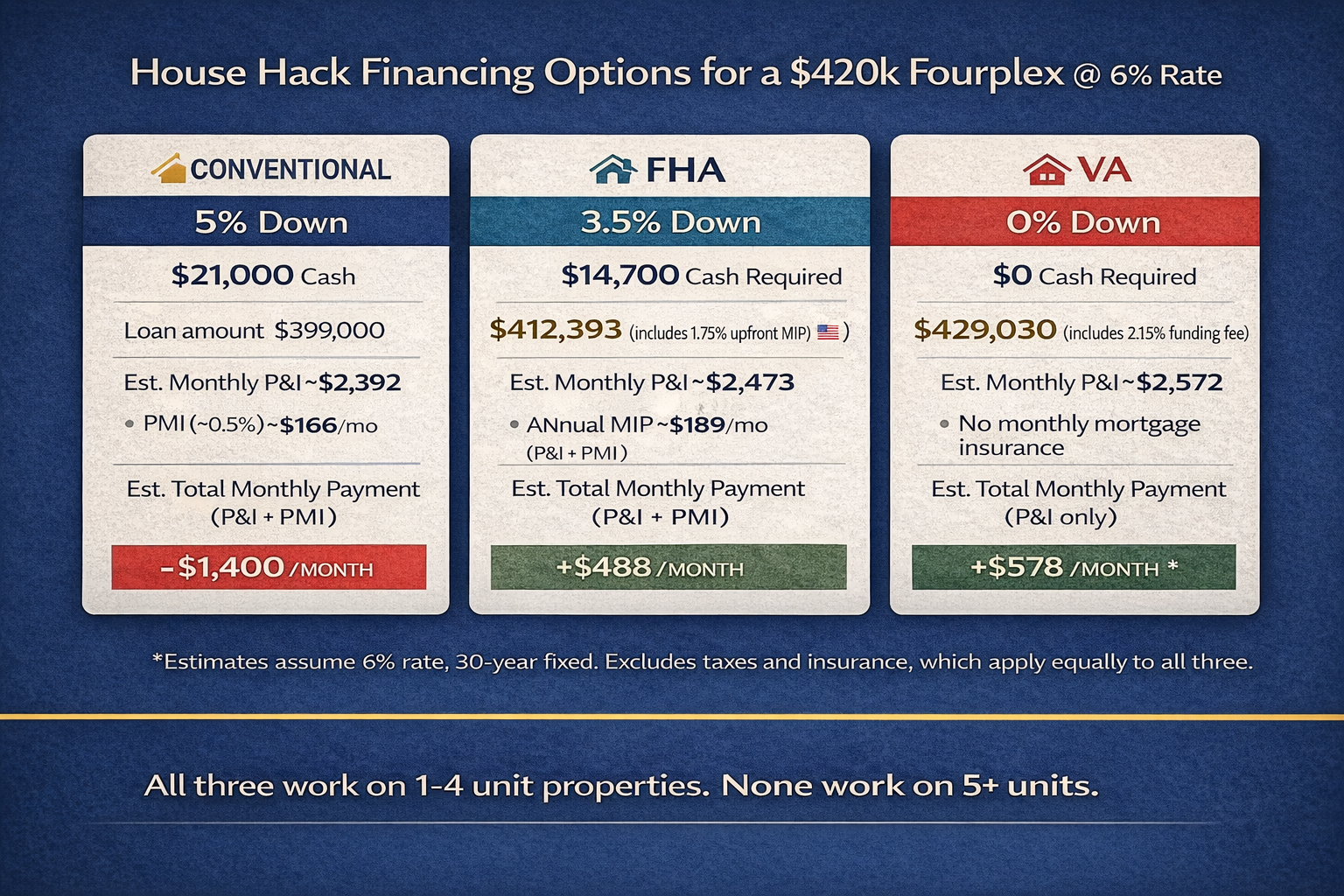
Real example: A fourplex in a mid-size market, purchased for $420,000 with an FHA loan at 3.5% down ($14,700 cash). The owner lives in one unit. The other three units rent for $1,100, $1,050, and $1,000 per month, totaling $3,150/month in gross rental income. Total mortgage payment on a 30-year FHA loan: approximately $2,650/month including principal, interest, taxes, insurance, and FHA mortgage insurance premium. Net cost to the owner for housing: roughly $0 to negative. The tenants are covering the mortgage, and in a stronger rent market, the owner nets positive cash flow while living rent-free.
The financing angle is critical: Because this is a 1-4 unit property, the owner-occupant can use:
- Conventional financing (as low as 5% down on a multi-unit owner-occupied purchase)
- FHA financing (3.5% down, available on 1-4 unit properties you intend to occupy)
- VA financing (0% down for eligible veterans, available on 1-4 unit owner-occupied properties)
This is why the 1-4 unit threshold matters. A five-unit building cannot be purchased with FHA or VA financing, regardless of whether you intend to live in one of the units. The house hack strategy is only available in the residential financing envelope.
Metrics that matter:
- Effective housing cost (mortgage payment minus rental income). This is the number most house hackers optimize for.
- DSCR on the rental units: do the non-owner units cover the full debt service?
- Appreciation trajectory. House hackers often exit the owner-occupied unit after a few years, convert it to a rental, and repeat elsewhere.
Management intensity: Moderate. You live on-site, which makes minor maintenance faster to address and tenant issues harder to ignore. On-site ownership tends to produce better tenant behavior, which is a genuine benefit.
Best for: First-time investors, investors with limited capital, and anyone who wants to significantly reduce or eliminate their housing expense while building a real estate portfolio. This is the most accessible entry point in residential investing.
Strategy 3: Mixed-Use Strategy (Different Units, Different Plays)
What it is: Running different units of the same building under different rental strategies simultaneously. Long-term lease in two units, short-term rental in one unit, mid-term rental in another.
Real example: A fourplex in a city with a strong hospital system and moderate tourism. The investor runs:
- Units A and B: 12-month leases at $1,200/month each to long-term tenants
- Unit C: Furnished mid-term rental targeting travel nurses at $2,200/month on 13-week contracts
- Unit D: Short-term rental on Airbnb at $130/night, running 65% occupancy ($2,535/month gross)
Gross monthly revenue: $1,200 + $1,200 + $2,200 + $2,535 = $7,135. Compare that to running all four units as LTRs at $1,200 each, $4,800/month gross. The mixed strategy generates 48% more revenue on the same building.
Why this works: Each unit can be optimized independently based on demand in that market. If the STR market softens, Unit D can be converted to an LTR without touching the rest of the building's income. The strategy provides built-in optionality.
The complication: You are now operating three different rental businesses under one roof, each with different expense profiles, different accounting, different income volatility. The long-term units have expense ratios around 35-40%. The STR unit runs closer to 50%. The MTR unit sits somewhere in the middle. Averaging these together gives you nothing useful.
Metrics that matter:
- Revenue per unit (tracked separately by unit and strategy)
- Expense ratio per unit type. Do not aggregate across strategies.
- Blended cap rate and cash-on-cash (portfolio-level view, after per-unit analysis)
- Vacancy days per unit. Each unit's downtime has a different cost.
Management intensity: High. You're running two or three different operating models simultaneously. Property management software that understands multi-strategy assets is not optional at this point.
Best for: Investors in markets with multiple demand drivers (tourism + healthcare + corporate) who are willing to actively manage multiple rental strategies in exchange for premium blended revenue.
Strategy 4: Student Housing by the Bed
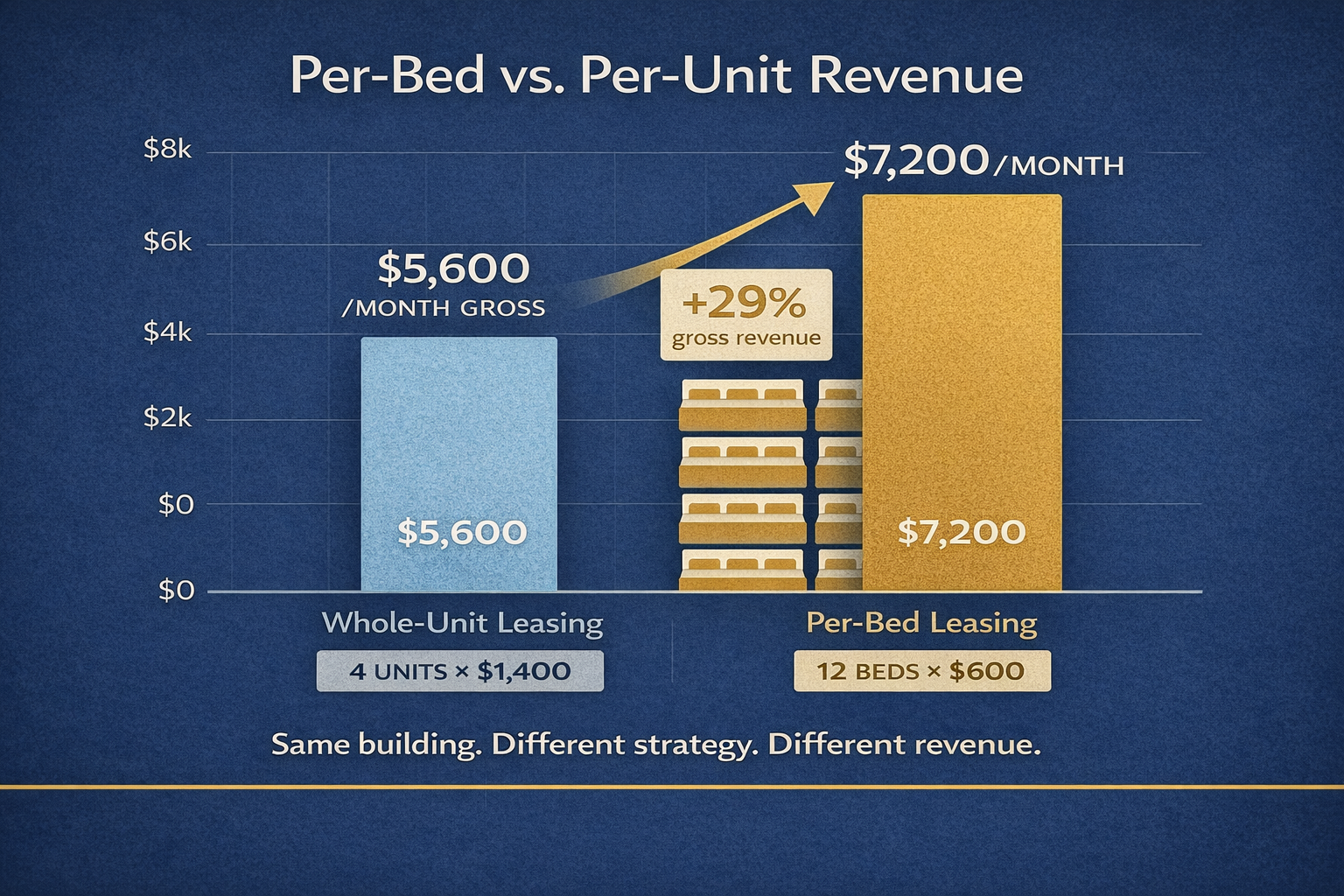
What it is: Rather than leasing each unit as a whole, the investor leases individual bedrooms within each unit to separate tenants under separate lease agreements. A fourplex near a university campus, each unit with three bedrooms, can generate 12 separate rental streams instead of four.
Real example: A fourplex a half-mile from a state university campus. Each unit has three bedrooms. Standard whole-unit rental for a 3BR in this market: $1,400/unit. Per-bed leasing at $600/bed across three beds: $1,800/unit. Across four units: $7,200/month gross vs. $5,600/month gross for whole-unit leasing. The per-bed premium is 29% more gross revenue on the same building.
Parents frequently co-sign individual leases, which reduces the practical default risk. Joint-and-several liability (where each tenant in a unit is responsible for the full rent if a roommate defaults) is also commonly used, depending on your state's laws.
The vacancy math is different here: A vacancy in one bed in one unit affects one-twelfth of your gross revenue, not one-fourth. The granularity of income protection is even finer than whole-unit multi-family.
Metrics that matter:
- Revenue per bed (the per-unit comparison metric)
- Semester occupancy vs. summer occupancy. Student housing in most markets has a structural summer vacancy trough of 2-3 months. Plan for it.
- Turnover cost per bed. Annual paint, carpet, and cleaning costs per bedroom multiply across 12 beds.
- Total tenant count (lease administration scales with headcount, not unit count)
Management intensity: High. Twelve tenants instead of four means twelve separate rent payments, twelve maintenance requests, twelve lease renewals. A building like this is not a passive investment. It runs like a small residential rental business.
Best for: Investors within close proximity to large university campuses who are willing to manage higher lease complexity and higher turnover in exchange for above-market gross revenue per square foot.
Strategy 5: Section 8 / Subsidized Housing
What it is: Renting to tenants who hold Housing Choice Vouchers (the program commonly called Section 8), where the federal government pays a portion of the rent directly to the landlord each month. The tenant pays the remainder based on their income.
Real example: A duplex in a mid-size southern city. Unit A is a standard market-rate LTR at $1,300/month. Unit B is rented to a Section 8 voucher holder. Fair Market Rent (FMR) for the unit in this county is $1,280. HUD pays $1,050 directly to the landlord. The tenant pays $230. Total rent: $1,280, slightly below market, but the $1,050 portion arrives from the government on time, every month, regardless of whether the tenant has had a hard month.
The case for it: Government-guaranteed partial rent eliminates the most common cash flow disruption in residential real estate, tenant non-payment. Eviction proceedings for a Section 8 tenant are no faster or easier than for any other tenant, but the income risk profile is materially different.
The requirements: Units must pass HUD Housing Quality Standards (HQS) inspection before a voucher holder can move in. Inspections repeat annually. Units must be maintained to these standards throughout tenancy. This is not optional and it is not lightweight. Inspectors will flag items that a standard LTR tenant would never bring up.
What investors get wrong about Section 8: The assumption that voucher holders are high-risk tenants. Voucher holders have strong incentive to maintain their voucher, as losing it requires years on a waiting list to get back. Eviction for cause results in voucher loss in many circumstances. This creates a different incentive structure than a market-rate tenant with no government stake in the outcome.
Metrics that matter:
- Government vs. tenant portion of rent (income stability analysis)
- FMR (Fair Market Rent) relative to market rent. In some markets, FMR is above market; in others it's below.
- Inspection compliance costs. What does keeping units at HQS standards cost per year vs. standard maintenance?
- Vacancy between voucher holders. Waiting lists mean motivated tenants, but the placement process takes longer.
Management intensity: Moderate. More paperwork and annual inspection overhead than standard LTR. Income stability is significantly higher. Many investors find the tradeoff strongly favorable in markets with high eviction rates or volatile tenant populations.
Best for: Investors in markets where Section 8 FMR is at or above market rate, and investors who prioritize income reliability over income maximization.
Strategy 6: BRRRR Multi-Family
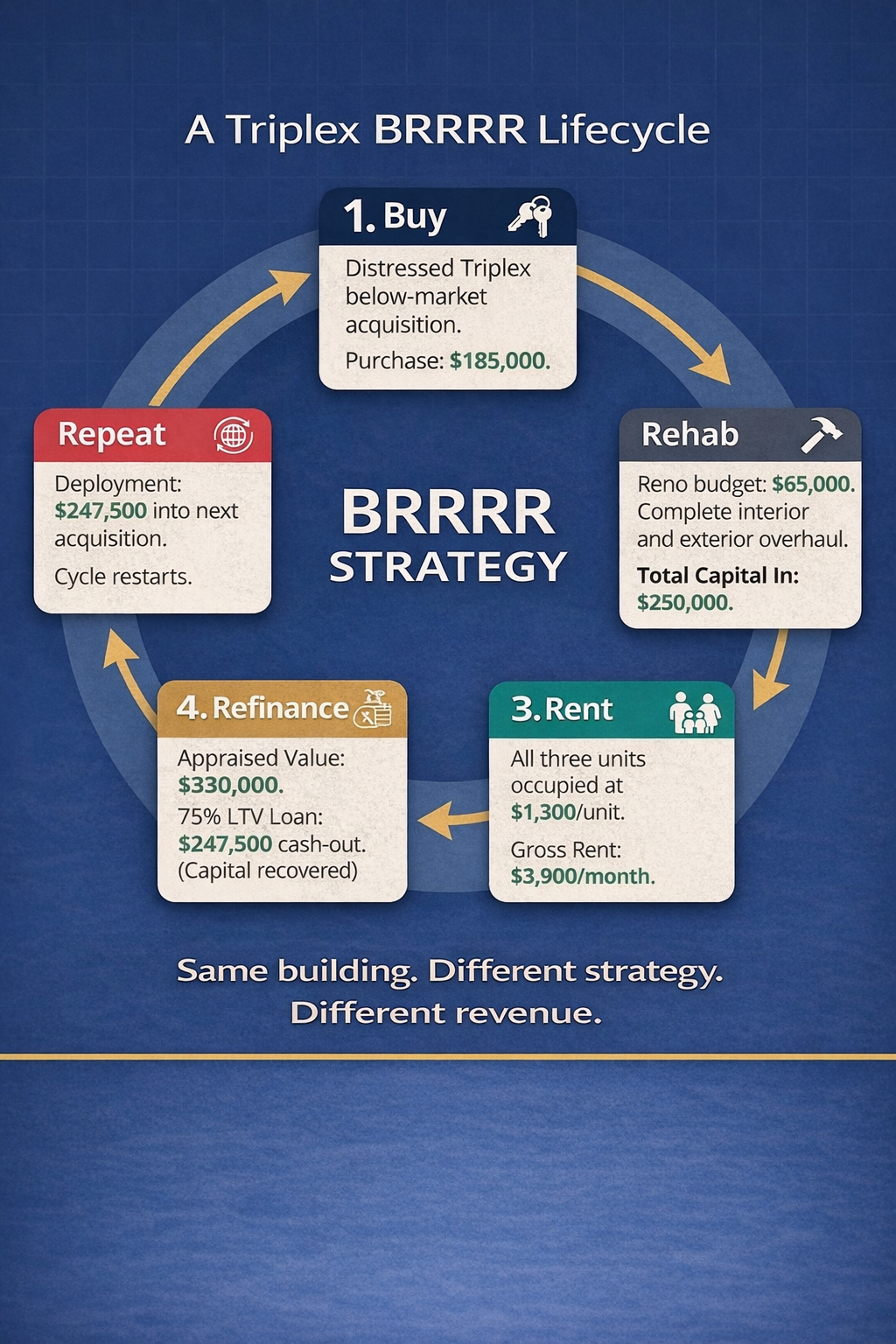
What it is: Buy, Rehab, Rent, Refinance, Repeat, applied at the small multi-family scale. Buy a distressed duplex or triplex below market value, renovate it to force appreciation, rent all units at market, refinance out the equity created, and use that capital to acquire the next property.
Real example: A triplex in a transitioning neighborhood, purchased for $185,000 in as-is condition. Market-rate rents for renovated units in the area: $1,300/unit. The units are currently in rough shape, partially occupied at $750/unit. The investor puts $65,000 into a full rehab: new kitchens, bathrooms, flooring, HVAC, roof. After renovation, the building appraises at $330,000.
Post-rehab rent roll: $1,300 x 3 = $3,900/month. NOI at 40% expense ratio: $2,340/month, or $28,080/year. At a 7% cap rate, the building is worth approximately $401,000. The investor refinances at 75% LTV, pulling out $247,500. Total cash into the deal: $185,000 purchase + $65,000 rehab = $250,000. Cash returned via refinance: $247,500. Net cash left in the deal: $2,500. A nearly complete capital recycling event, with a stabilized rental asset that pays its own mortgage going forward.
Why small multi-family is the ideal BRRRR vehicle: Distressed 2-4 unit buildings often exist at the price point where institutional buyers are not competing. A distressed $185,000 triplex does not attract REITs or large syndicators. Individual investors with construction management skills and access to conventional residential financing can acquire and rehabilitate these properties in ways that are not possible in larger commercial categories.
The financing stays residential: Even as a BRRRR investor, the 1-4 unit building qualifies for conventional residential refinancing, not commercial. This matters for rate, LTV, and qualification requirements.
Metrics that matter:
- All-in cost (purchase + rehab) vs. after-repair value (ARV). The spread is your equity creation.
- Cash left in deal post-refinance. The lower this number, the faster you can recycle into the next acquisition.
- Post-refinance DSCR. Does the stabilized building service its new, higher loan balance?
- Time to stabilization. How long from purchase to fully rented and refinance-ready?
Management intensity: Very high during acquisition and renovation. Stabilizes to moderate once all units are rented. BRRRR is an active investment strategy, not a passive one. You're acting as both investor and project manager during the rehab phase.
Best for: Investors with construction experience or strong contractor relationships, access to short-term capital for the purchase and rehab period, and a tolerance for project-phase intensity in exchange for forced appreciation and capital recycling.
Why Per-Unit Analysis Is Not Optional in Multi-Family
Here is where this gets practical for anyone who owns or is modeling a 2-4 unit property.
In a single family home, vacancy is binary. The property is rented or it isn't. There is no "partial occupancy." There is income or there is no income.
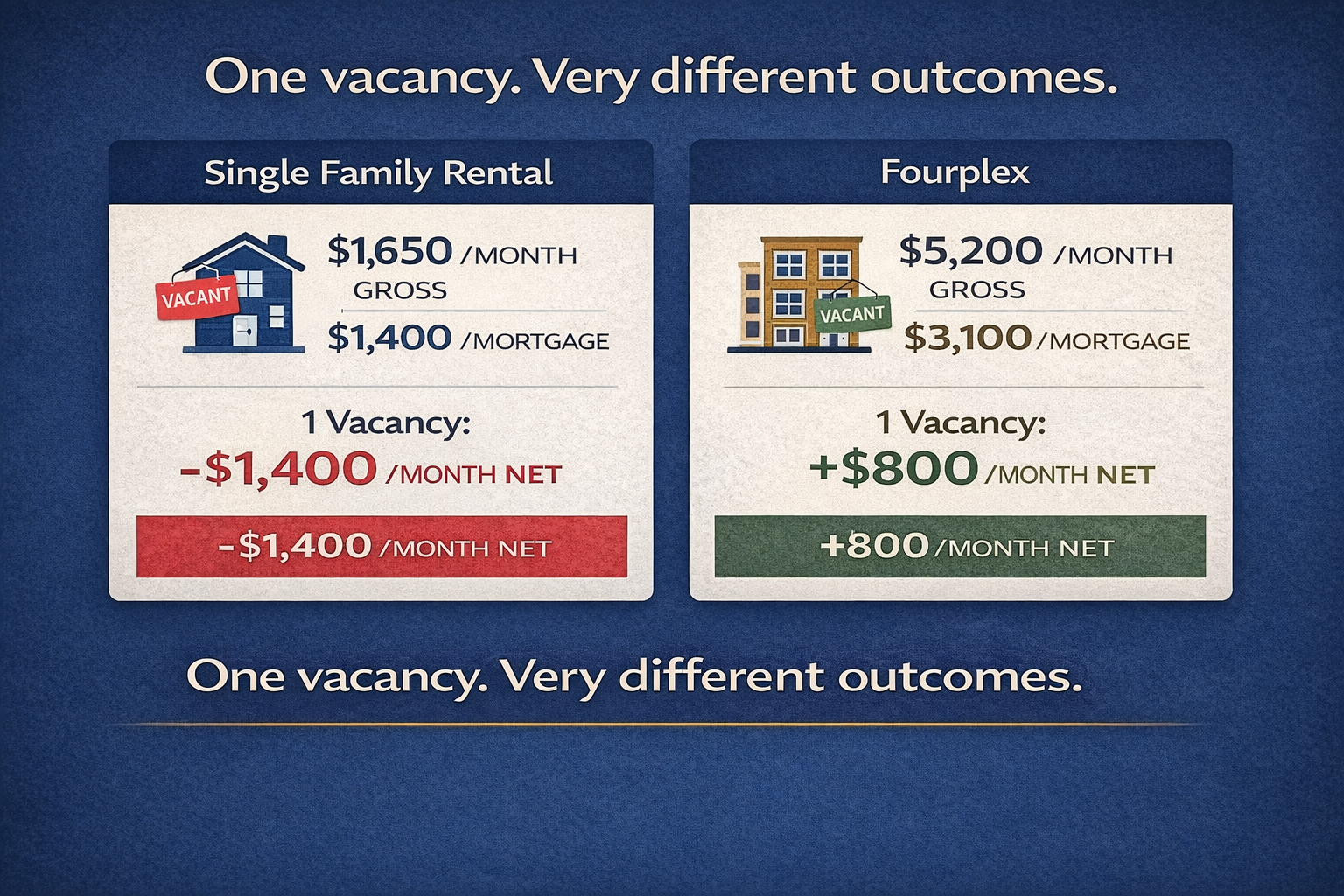
In a fourplex, vacancy is 25% increments. One empty unit is not "a vacancy." It is a 25% revenue reduction. The math of that matters differently depending on your debt service:
If your fourplex generates $5,200/month gross fully occupied and your mortgage is $3,100/month, a single vacancy leaves you with $3,900/month, still above debt service, still cash-flow positive. Your DSCR dropped but you did not go negative.
If your single family rental generates $1,650/month and your mortgage is $1,400/month, a vacancy leaves you with $0. You are $1,400/month negative until you fill it.
This structural resilience, not the income potential, is the most underappreciated argument for small multi-family over single family for cash flow investors.
The flip side: every unit also has its own capital expenditure exposure. One vacancy is one unit to re-lease. One HVAC failure can be one of four systems. The expenses multiply with the units, not just the income. This is why per-unit expense tracking is as important as per-unit revenue tracking.
For more on the core metrics that apply across every strategy above, the DSCR explainer walks through the calculation and what threshold to target by property type.
How Nimbus Handles This
The six strategies above are not labels. They determine what gets calculated, what gets modeled, and what your portfolio actually tells you.
A fourplex running Strategy 1 (all units LTR) needs cap rate, DSCR, and per-unit cash-on-cash tracked at the unit level and the building level. A fourplex running Strategy 2 (house hack) needs the owner-occupied unit excluded from income metrics but included in equity and net worth calculations. A fourplex running Strategy 3 (mixed-use) needs separate expense ratios, separate vacancy tracking, and separate revenue analysis for each unit's strategy, while still rolling up to one building in the portfolio view.
Most trackers give you one bucket for the building and one number for the income. That's not analysis. It's accounting.
Nimbus Portfolio tracks each property at the asset level, with category assignments that drive which metrics are calculated and which scenarios are available. A house hack gets a different dashboard than a pure investment multi-family, because the financial questions you're asking are different. If you convert the owner-occupied unit to a rental when you move out, the category updates and the metrics recalibrate. See how a mixed portfolio looks from a single view.
If you are modeling a new acquisition, you can run the buy scenario with real numbers, check DSCR before you make an offer, and see your projected cash-on-cash return, all without creating an account.
What Comes Next in This Series
This is Part 2 of a 16-week series. Next up: what changes when you cross the 5-unit threshold. Different financing, different valuation methods, different management infrastructure, and a set of strategies that look nothing like what's described above.
Start Tracking Your Multi-Family Property the Way It Actually Works
A duplex is not the same investment as a fourplex running a house hack with a mixed-use unit. They're different financial instruments that happen to qualify for the same loan. The strategy you're running, or the one you've defaulted into, determines your income, your cash flow resilience, your management burden, and how your portfolio performs over time.
Track them accordingly. Per unit, per strategy, one portfolio view.
Add your first property in under two minutes and see your numbers the way they actually work. Get started at Nimbus Portfolio
Nimbus Portfolio tracks 19+ real estate asset types and categories. Free tier available. Portfolio plan at $24/month or $190/year. Portfolio+ at $49/month or $390/year.
Frequently asked questions
What is house hacking a duplex?
House hacking means living in one unit of a 2-4 unit property while renting the others. You qualify for owner-occupied financing, often 3.5 percent down with FHA or 5 percent with conventional, and your rental income offsets your housing cost. After 12 months you can move out and keep it as a full rental.
Is a fourplex still considered residential for financing purposes?
Yes. Up to four units is residential for lending. You qualify for conventional, FHA, or VA loans and the lender evaluates your personal income. At five units it becomes commercial, which changes the down payment, underwriting, and appraisal entirely.
How is rent-by-the-room different from a traditional lease?
Renting by the room treats each bedroom as a separate lease, usually to students or young professionals sharing common areas. Gross income often exceeds a whole-unit lease, but turnover, utility bills, and management workload all go up. Zoning and local occupancy limits can block this strategy.
Does Section 8 pay market rent?
Section 8 pays the Fair Market Rent set by the local housing authority, which is sometimes above and sometimes below market. The tradeoff is guaranteed rent paid directly by the government, longer tenancy, and an annual inspection that enforces a minimum property standard.